Meta Ads for Ecommerce in 2026: The Full-Funnel Structure That Actually Scales


If your Meta account is split into too many campaigns, you may be starving the system of purchase data. My short take is simple: keep the account tight, optimize for Purchase only, let ASC handle most acquisition, use one manual test campaign for new ad angles, and keep retention small and separate.
Here’s the article in plain English:
- I see scaling work best when brands feed Meta more purchase data in fewer places
- For ecommerce, I would not optimize for add to cart or initiate checkout
- The main setup is:
- ASC for most spend, usually 60%–80%
- Manual testing for new ads
- Retention for past buyers, usually 5%–15%
- Tracking matters: run Pixel + Conversions API, set Purchase as the top event, and compare Meta with Shopify, Triple Whale/Hyros, Klaviyo, and Stripe
- I’d only split out retargeting when I need tighter message control
- Ad angles do most of the audience work now: problem-solution, demos, proof, authority, objections, and before/after
- I’d set targets from contribution margin, not gut feel
- I’d scale when CPA is under target and purchase volume is dense, sometimes by 50% to 200%
- The structure stays mostly the same across brands; the ads and offer framing change by category
A few numbers from the piece show the pattern: $239,000 in spend to $1.98 million in revenue at 8.27 ROAS, $544,397 in 72 hours for Black Friday, and $15,000 to $150,000/month in six months on one case.
If you run a US ecommerce brand doing $50,000 to $2 million per month, this article is about one thing: how I keep Meta accounts simple enough to learn, but strict enough to scale.
For a recent example of how I adapted the structure to an acquisition brief, read the US jewelry Meta ads case study. I used a CBO-only structure, tested cost caps, and directed spend toward new customers. Blended ROAS rose from approximately 2.13 to 2.57 while new-customer CPA fell 22.42%. The jewelry acquisition strategy breakdown explains the management decisions behind the numbers. Use that case to understand the tradeoffs alongside the structure discussed here.
The 2026 Meta Account Structure: Consolidated, Signal-First, Purchase-Only
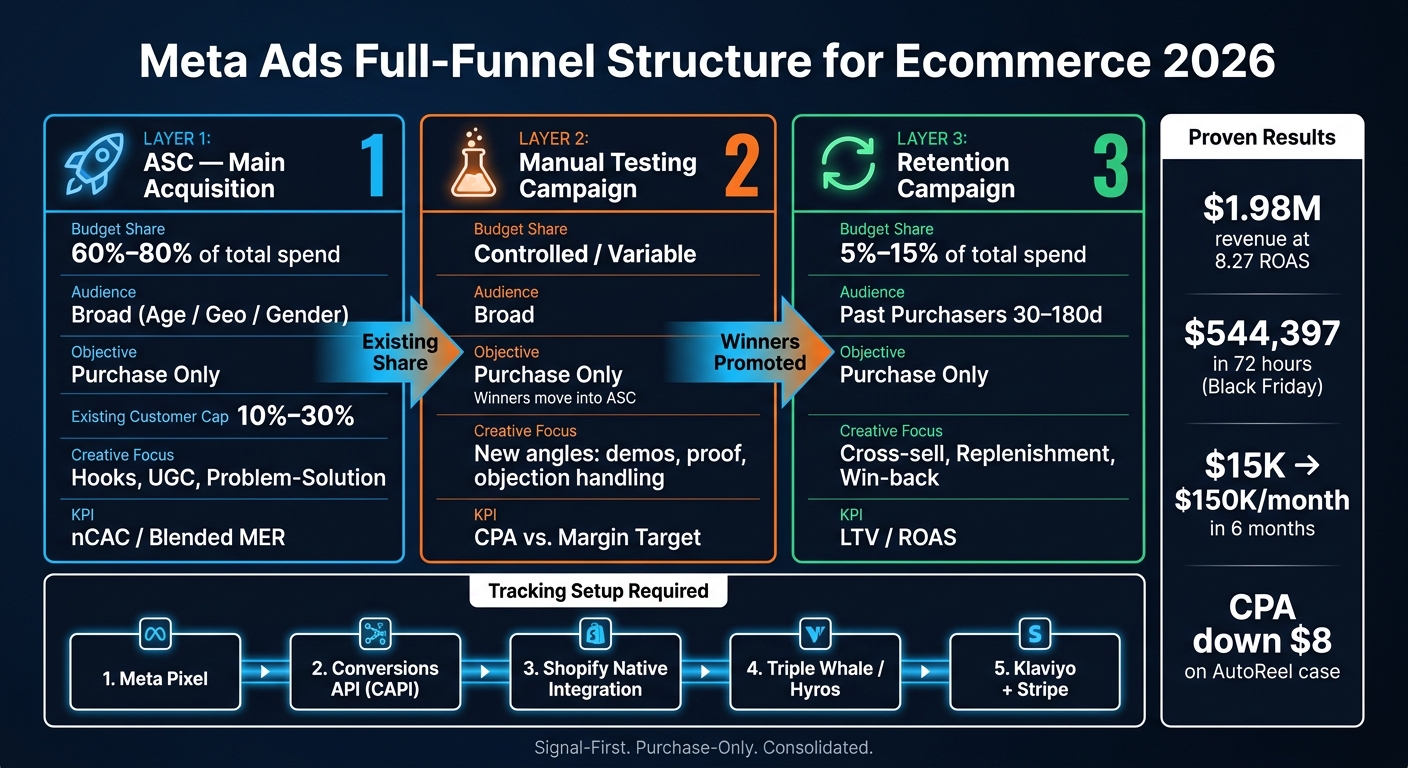
Meta Ads Full-Funnel Structure for Ecommerce 2026
Why Old Funnel Silos Break in 2026
The old setup looked tidy: one campaign for cold traffic, one for warm traffic, one for retargeting, and one for retention. It made sense on paper. In practice, it usually underperformed.
When you split budget across 10–15 campaigns, each ad set ends up short on purchase data. Meta doesn't get enough clean signal to figure out who actually buys. That's why the better setup now uses fewer campaigns, not more.
Meta now leans harder on creative range and purchase signal than on tight audience splitting. Put simply, the ad does more of the sorting. A strong discovery hook can bring in cold buyers. A testimonial or proof-heavy angle can pull in warmer buyers. And that can happen inside one broad system without constant audience tinkering.
Consolidation wins because it puts more signal in one place, cuts down on learning resets, and keeps reporting closer to blended MER.
The Campaign Stack I Use Now
My standard Meta Ads management stack has three layers.
Layer 1 - Main ASC. This is the backbone. It usually takes most of the budget, often 60%–80%. I keep it broad and optimize ONLY for Purchase. I cap existing customers at 10% to 30% so ASC keeps going after net-new buyers.
Layer 2 - Manual testing campaign. This is where I test new creative concepts. The budget stays controlled. Targeting stays broad. The objective is Purchase only. If an angle shows it can drive profitable purchases, I move it into ASC.
Layer 3 - Retention campaign. This sits on its own for past purchasers: cross-sells, upsells, and win-backs. It stays lean, usually 5%–15% of spend.
That's the structure. ASC handles most of the middle without the old funnel setup forcing fake separation. But this only works when tracking is clean, which leads to the next part.
Tracking and Attribution That Support Scaling
Tracking is what makes consolidation work. It isn't some side task.
I run Meta Pixel and Conversions API together. Pixel by itself misses too much. CAPI sends more purchase data back server-side. If you're on Shopify, use the native integration. No custom code needed.
Inside Events Manager, I pay close attention to Event Match Quality. I want it as high as I can get it. I send email, phone, and name on every event possible. In Aggregated Event Measurement, Purchase stays the top priority.
For reporting, I treat platform ROAS as a check, not the final call. I cross-check Shopify, Triple Whale or Hyros, Klaviyo, and Stripe. If those numbers start drifting apart, I slow spend before I scale.
Once the account is clean, the next issue is how ASC handles cold, warm, and returning buyers without rebuilding the old funnel setup.
How Full-Funnel Works in the ASC Era
Full-funnel in 2026 looks a lot simpler than it used to. Instead of a messy account packed with overlapping campaigns, it usually comes down to one signal-first setup with three clear jobs: ASC for prospecting, one manual testing campaign to find new angles and feed winners into ASC, and a small retargeting and retention layer. Once tracking is clean, full-funnel becomes a job-allocation problem, not a campaign-sprawl problem.
Prospecting Inside ASC
Prospecting should stay broad. That means no interest stacks, no lookalikes, and no constant audience tweaks. Creative does the targeting. A UGC hook can pull in cold buyers. A testimonial or problem-solution angle can speak to people who are a bit warmer. From there, Meta pushes spend where the signal is strongest.
The main checks are straightforward: CPA against margin target and blended MER across the account. If those numbers stay in line, I’m comfortable giving the campaign more budget.
From there, the next call is pretty simple: only split warm traffic into its own campaign when message control matters.
Retargeting and Retention Without Overbuilding
ASC already takes care of some retargeting on its own. I keep existing customers capped inside ASC so the campaign stays focused on acquisition. I only break retargeting out when I need tighter control over the message, like testimonials, objection handling, or a DPA that shows the exact product someone viewed.
If I run a dedicated retargeting campaign, I keep it narrow:
- Site visitors from the last 30 days get trust-building creative
- Past purchasers get cross-sell, replenishment, or win-back messaging
Everything still optimizes for Purchase.
Retention mostly sits in Klaviyo and SMS. I use Meta for that layer only when there’s a clear reason to hit the list again, like a new product drop, a loyalty offer, or a strong replenishment push. I keep this piece small and separate from prospecting so it doesn’t pull budget away from acquisition.
| Prospecting | Retargeting | Retention | |
|---|---|---|---|
| Campaign Type | ASC / Manual Broad | Manual CBO / DPA | Manual / Catalog |
| Audience | Broad (Age / Geo / Gender) | Site Visitors 0–30d | Past Purchasers 30–180d |
| Creative Focus | Hooks, UGC, Problem-Solution | Testimonials, Objection Handling, DPAs | Cross-sell, Replenishment, Win-back Offers |
| Primary KPI | nCAC / Blended MER | Incremental Lift | LTV / ROAS |
Keep each layer narrow and let it do one job. Next, creative angle families and margin thresholds decide how far this setup can scale.
Creative, Margins, and the Scaling Rules That Decide Whether You Win
Creative Angle Families That Scale DTC and SaaS
Once the account is consolidated, creative is what decides if it can scale. In 2026, creative does the targeting.
Across GLD, Lalo, Young Nails, ShopPriceless, and my 60+ brand roster, I keep coming back to six angle families:
- Problem-solution: name the pain and show the fix
- Transformation: before-and-after change
- Product demo: show how the product works
- Social proof: real customers, real words
- Authority: expert backing and credentials
- Objection handling: reduce risk and justify price
I keep new concepts moving at all times. That’s why I built ADEN'S LAB. The the real estate AI SaaS tool case shows the pattern: $15K to $150K/month in six months, with CPA down $8.
Set Targets From Contribution Margin, Not Gut Feel
ROAS without margin context means nothing.
Before I scale, I work backward from contribution margin: AOV minus COGS, fulfillment, shipping, platform fees, and overhead. Start there, back into target CAC, and then set your floor above break-even ROAS.
That 8.27 ROAS run is the ceiling I use when economics and creative line up.
Once the math works, budget speed becomes the next lever.
Scaling Gates, Cost Caps, and When to Push the Budget Hard
Once a campaign is inside target and has dense purchase signal, I push budget by 50% to 200%. That’s not reckless. That’s what a real winner can hold.
I launch on lowest cost. I move to cost caps only after the campaign proves it can hold efficiency at scale. The $1,011,172 through one cost-caps campaign at 3.90 ROAS came from that sequence. So did the $814,769/month at 4.51 ROAS run.
Black Friday 2025 was the stress test: $544,397 in 72 hours, with a single day at $43,193. That only happens when creative is fresh, tracking is clean, and I’m willing to push hard when the numbers say go.
| Situation | Recommended Action | Monitoring Notes |
|---|---|---|
| CPA < Target + Dense Signal | Increase budget 50–200% | Watch for CPM spikes or CVR decay |
| CPA at Target + Rising Frequency | Hold; refresh creative angles | Don't scale until new creative is in rotation |
| CPA > Target + High CTR | Fix the landing page | Check site speed and checkout friction |
| CPA > Target + Low CTR | Cut or rotate creative | Move budget to winning angle families |
When CPA rises, I rotate creative first. Then I decide whether the campaign still deserves more spend.
Next, I’ll show how this structure adapts by brand type.
What This Structure Looks Like Across Real Brands
How the Same Structure Adapts Across Brand Types
Once the structure is working, the vertical only changes the creative.
I keep the structure the same and swap the creative. GLD needs lifestyle. Lalo needs education. Young Nails needs demos. ShopPriceless needs social proof. The stack stays the same: ASC Scaling, Manual Testing, Retargeting, and DPA Retargeting.
That structure stays fixed because the signal stays fixed. Across every brand I run, the constants are purchase signal, creative pressure, and unit-economics discipline. Beauty and supplements usually need faster repetition and more objection handling. Home and furniture usually need more social proof and a longer consideration window.
Where to See the Work and What to Do Next
When the structure is in place, you can see it in the numbers.
The Black Friday 2025 case shows what this looks like under Black Friday pressure - $544,397 in 72 hours. That kind of result happens when the account is ready before the sale starts.
The the real estate AI SaaS tool case shows the pattern when growth is driven by creative: $15K to $150K/month in six months, with CPA down $8. ADEN'S LAB is the engine behind that creative speed. You can see the full roster at /experience.
If you want my eyes on your account, start here. If you want to see how I price and structure the work, go to /services. If you want to talk through your account in detail, book a 30-minute strategy call - direct with me, you leave with a diagnosis either way.
FAQs
When should I use ASC vs. manual campaigns?
Use ASC as your main growth engine for broad acquisition once you have enough pixel data, usually 500+ purchase events in the last 30 days. At that point, Meta tends to do a better job of distributing spend across the funnel without much hand-holding.
Use manual CBO campaigns when you want more control over prospecting or need to test new creative angles, offers, or audiences. Once something starts working, move those winners into ASC so you can scale with less manual input.
How much budget should go to retention?
Shift your retention budget away from Meta and into owned channels like Klaviyo and Attentive.
Some brands put 10% to 15% of their Meta spend into retention campaigns. But a stronger move is to let Meta do what it does best: drive net-new customer acquisition through ASC.
Here’s the problem with using Meta for retention: it can make ROAS look better than it is, without showing true incremental revenue. On paper, the numbers may look strong. In practice, you may just be paying to reach people who were likely to come back anyway.
Keep Meta spend focused on feeding the top of the funnel. That gives you a cleaner view of performance and sets up longer-term growth.
How do I know when to scale budget fast?
Scale fast once you’ve found a winning creative and moved it into your ASC. If results stay steady, budget increases of 50% to 100%+ are normal.
Don’t inch up in 5%–10% steps. If the data supports the move, the algorithm can handle bigger budget jumps. You also want enough spend to drive at least 50 purchase events per week to keep performance steady.
Continue with a focused diagnosis
Use these guides when the next decision needs a more specific worksheet or investigation.