BFCM Meta Ads Playbook: How I Deployed $544K in 72 Hours


BFCM results are set weeks before Black Friday. In this playbook, I show the system behind $544,397 in Meta ad spend over 72 hours, with 32.5 million impressions and 0 account freezes.
If you need Meta ads management services for a U.S. ecommerce or SaaS brand, here’s the short version: prep in October, keep campaign structure simple, map budgets before Thanksgiving week, watch MER over platform ROAS, and make small budget moves during the sale. The goal is not perfect hourly efficiency. The goal is control when CPMs jump and volume spikes.
Here’s what you’ll get from this article:
- What to fix before BFCM: offer, tracking, approvals, billing, and account setup
- How I set up campaigns: testing, scaling, and promo campaigns with broad targeting
- How I plan spend: phase budgets across pre-launch, teaser, peak sale, and post-sale days
- How I manage the weekend: check data every 3–4 hours on Black Friday and Cyber Monday
- What I do after Cyber Monday: reset campaigns, segment buyers, and carry wins into December
A few numbers shape the whole approach:
- No more than 20% budget increases in 24 hours on winning ad sets
- Frequency above 4.0 + falling CTR usually means ad fatigue
- CPA 25%+ above target for 2 checks calls for a budget cut
- CPMs can run 50%–80% above normal during Black Friday week
This is a plain system you can use: build early, spend with control, then reset fast after the sale.
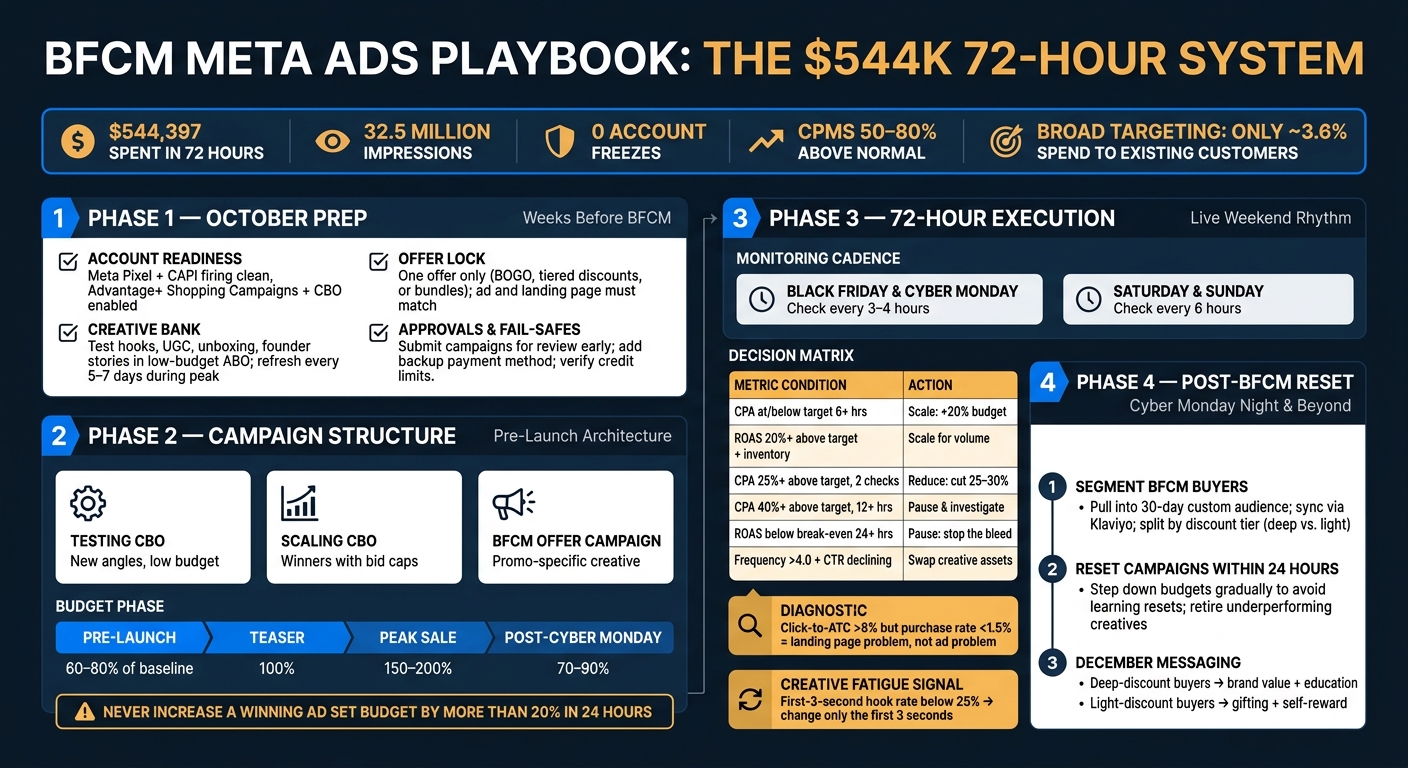
BFCM Meta Ads Playbook: 72-Hour Execution System
Read the source: the BFCM Meta ads case study includes the original screenshot, exact totals and an execution timeline. It shows $544,397.42 in spend, 32,527,317 impressions and 10,803,882 reported reach. I describe the engagement as a 72-hour run; the export’s selected reporting dates are November 28–December 1, 2025. Revenue and ROAS are not visible in that screenshot.
BFCM Is Won in October
The $544,397 weekend didn’t happen because someone scrambled during Thanksgiving week. It happened because the account was already tight, the creative had already been tested, and the budget was already planned out before the rush hit. By Black Friday week, structural issues cost too much to fix.
Check If Your Account Is Ready to Scale
Start with account readiness. Pull data from Meta, Shopify, and your attribution tool. Then look at the basics: does the offer convert, is tracking clean, and does performance hold up outside the holiday spike? If October is messy, BFCM will just make that mess bigger.
Clean up the account structure before traffic ramps up. Use Advantage+ Shopping Campaigns and CBO so Meta can handle more volume without constant learning resets.
Build Your Offer and Creative Bank Early
Choose one offer and stay with it. That could be BOGO, tiered discounts, or bundles. Then make sure the ad and landing page say the same thing. If the message shifts between the click and the page, conversion rate drops.
Creative is what swings BFCM. I use ADEN'S LAB to make tens of thousands of creative variations, then trim that list to the winners. In October, I test hooks, UGC, unboxing, founder stories, and bundle angles in low-budget ABO tests. The ads that win in October are the ones that get more spend in November. During peak season, I refresh creative every 5–7 days to fight fatigue.
Lock Tracking, Approvals, and Fail-Safes Before the Rush
This is the dull stuff that saves the weekend. Meta Pixel and CAPI need to fire the right way by October 1 so you can collect as much data as possible before CPMs jump.
Get campaigns submitted for review in October too. Meta’s ad review slows down during the holiday rush, so pre-built campaigns are less likely to get stuck. Add a backup payment method, and check that the main card has enough available credit. A failed payment during BFCM can pause delivery or even disable the account.
Once the account, offer, and creative bank are set, campaign structure becomes the next bottleneck.
Campaign Architecture for BFCM Meta Ads
Once creative and tracking are set, structure becomes the thing that sets the pace. When the auction gets jumpy, too much complexity slows you down.
Use a Simple Account Structure Built for Volume
I run three campaigns: a Testing CBO for new angles, a Scaling CBO with bid caps for winners, and a BFCM Offer Campaign for the promo. I move winners using the same Post ID so social proof carries over.
I keep the account tight. I split campaigns only when the unit economics are different. That setup makes it much easier to move spend when budgets climb fast.
Choose Targeting and Bidding Based on Scale, Not Theory
Broad targeting is my default for scaling. No interests. No demographic filters. No lookalikes stacked on top. In a high-spend broad setup, only about 3.6% of spend usually goes to existing customers. I use lookalikes only when purchase volume is light - fewer than 500 monthly purchase events.
For bidding, I match the strategy to the job:
| Bidding Strategy | Downside | Stability | Scale | Best Use |
|---|---|---|---|---|
| Highest Volume | High | Low | Maximum | Aggressive acquisition, flexible margins |
| Cost Cap | Moderate | Moderate | High | Volume with a CPA target |
| Bid Cap | Low | Very High | Controlled | Hold ROAS floor in volatile auctions |
I use Highest Volume inside ASC for prospecting. I use bid caps inside the Scaling CBO when auction prices climb and I need to protect a ROAS floor.
Map Your Budgets Before Thanksgiving Week
Weekend budget calls are usually reactive. I plan the full budget four weeks in advance and prebuild the schedule.
One rule matters here: never increase a winning ad set's budget by more than 20% in 24 hours. Push past that, and you can reset the learning phase. I start Black Friday above target spend so I can scale down if needed instead of asking Meta to catch up in the middle of the day.
I map the window in phases:
- Pre-launch at 60–80% of baseline
- Teaser at 100%
- Peak sale at 150–200%
- Post-Cyber Monday extension at 70–90%
Short-term ROAS compression is fine if the margin and payback window can support it. The $544,397 weekend was built for control, not perfect efficiency every hour.
With structure and budgets mapped, the weekend turns into hourly decision-making.
The 72-Hour Operating Rhythm
The $544,397 weekend wasn’t won in the auction. It was won in prep. By the time Black Friday started, the structure was set, and the job was simple: execute.
Run a Final 12-Hour Pre-Launch Check
Twelve hours before spend ramps up, I lock things down. No new creative tests. No account rebuilds. This window is for QA, not for making big moves.
I check CAPI and browser events, pause non-holiday pop-ups and banners, and make sure a backup card is active.
Once the account is locked, the work shifts to live decisions.
Make Hourly Kill and Scale Decisions From the Right Numbers
During the live window, I don’t rely on platform ROAS by itself. Cross-device buying behavior and privacy changes can make platform ROAS slow to reflect what’s happening. I watch MER first and new-customer ROAS second.
On Black Friday and Cyber Monday, I check performance every 3 to 4 hours. On Saturday and Sunday, every 6 hours is enough.
| Metric Condition | Action |
|---|---|
| CPA at or below target for 6+ hours | Scale - increase budget by up to 20% |
| ROAS 20%+ above target + inventory available | Scale - room to absorb higher CPA for volume |
| CPA 25%+ above target for 2 consecutive checks | Reduce - cut budget by 25–30% |
| CPA 40%+ above target for 12+ hours | Pause - investigate creative or offer |
| ROAS below break-even for 24+ hours | Pause - no recovery signal, stop the bleed |
| Frequency above 4.0 + CTR declining | Switch - creative fatigue, replace assets |
Here’s one diagnostic I use when CPA jumps: if click-to-ATC is above 8% but purchase rate is below 1.5%, the issue is usually the landing page or checkout, not the ad creative. Don’t shut off campaigns because of a site problem.
That rhythm keeps spend under control while the auction shifts around you.
Handle Creative Fatigue Without Rebuilding the Account
Mid-weekend is the worst time to rebuild anything. If you pause campaigns, duplicate ad sets, or launch new structures during BFCM, you can end up back in learning and waste delivery time.
I change the ad, not the account.
If a creative starts to wear out - frequency goes up, CTR drops, and the first-3-second hook rate falls below 25% - I change only the first 3 seconds. In many cases, that’s enough to get attention back without touching the structure.
When I need a fast swap, I pull a new asset from the creative bank and place it inside an ad set that already has momentum. I don’t build a new campaign unless something is broken.
Budget moves work the same way. I shift spend between current campaigns based on the decision matrix above. The framework stays the same: stable structure, asset swaps when needed. The hard stuff gets handled before the weekend, not in the middle of it.
After the weekend, the focus moves to keeping the winners in place and resetting for December.
After BFCM: Keep the Gains and Review the Data
Cyber Monday night isn't the finish line. The buyer list you built over that weekend is what you use next.
Segment BFCM Buyers and Reset Campaigns for December
Once the weekend ends, that buyer list becomes your next asset.
I pull BFCM purchasers into a 30-day custom audience in Meta and sync the list through Klaviyo. Then I add that list to Meta's Engaged Customers and Existing Customers audiences to strengthen signals, not to exclude buyers. After that, I split buyers by discount tier: flash-offer buyers vs. lighter-discount buyers.
That split matters more than most people think. People who bought on a deep discount usually need a different follow-up than people who bought with a smaller offer.
For the deeper-discount group, I lean on brand value, founder story, and product education - what to try next, and why it matters. For the lighter-discount group, I move faster into gifting season or self-reward messaging. December messaging should start right away.
Within 24 hours, I reset back to the always-on structure. I don't let BFCM-specific campaigns keep running on autopilot. I bring budget down in steps to avoid learning resets. Then I review MER, NC-ROAS, and creative metrics like thumb-stop rate and hold rate. I keep only the creatives that clearly beat the rest on thumb-stop and hold rate. Everything else gets retired.
That reset is what turns BFCM traffic into December revenue.
What Founders Can Copy From the $544,397 Weekend
The lesson isn't just the spend. It's the system that made that spend feel safe.
The $544,397 across 72 hours didn't come from a complicated setup. It came from choices made in October. The structure was simple. The creative bank was full. The budgets were mapped ahead of time. By the time the auction got expensive - with CPMs running 50–80% above normal during Black Friday week - there was nothing left to solve in the moment.
You can see the full execution breakdown at /work/blackfriday.
The Real BFCM Meta Ads Strategy
That's the system: October prep, 72-hour execution, then a clean reset for December.
If you want to see how the AI creative engine behind this scales across months, not just weekends, the ADEN'S LAB case study covers that. If you want to see how this looks inside one brand going from $15K to $150K per month, start with the the real estate AI SaaS tool case study. If you want to see how this applies to your account, my services page explains how I work.
Or skip straight to the diagnosis. Book a 30-minute strategy call - direct with me, you leave with a diagnosis either way.
FAQs
When should I start preparing Meta ads for BFCM?
Start preparing your Meta ads for Black Friday 8–10 weeks in advance. Put your focus on audience building, ad testing, and campaign setup.
That gives your campaigns time to move out of the learning phase before CPMs spike.
How much should I increase budgets during Black Friday weekend?
Increase budgets by up to 100% or more during Black Friday weekend. Put more spend in place before the peak days, then scale with care as demand climbs.
A good rule of thumb is the 20% daily increase rule. It helps you grow spend without kicking campaigns back into the learning phase.
Should I optimize for MER or platform ROAS during BFCM?
Optimize for MER during BFCM. Platform ROAS often trails actual performance, so it can give you only part of the picture.
Use multi-touch attribution tools like Triple Whale or Northbeam to get a clearer read on profitability.