How to Scale Facebook Ads From $1K to $10K a Day Without Killing ROAS


Most brands hurt ROAS when they scale because they add spend before the account is ready. From $1,000/day to $10,000/day, the pattern is simple: fix tracking, know your breakeven ROAS, keep account structure tight, keep ad supply deep, control bids, and judge performance at the account level.
Here’s the short version:
- Before scaling, I always make sure five things are in place: breakeven ROAS, clean Pixel/CAPI data, a site that converts on mobile, enough ad depth, and enough stable performance data.
- From $1,000 to $3,000/day, I keep spend concentrated in fewer campaigns and broader audiences so Meta gets stronger conversion signal.
- From $3,000 to $5,000/day, the main limit is usually ad fatigue, not targeting. If CTR drops and frequency climbs, I swap ads before ROAS slides.
- From $5,000 to $10,000/day, I use cost caps and shift dollars across testing, scaling, and promo campaigns instead of forcing one campaign to do all the work.
- At $10,000/day, I stop judging accounts by campaign ROAS alone. I look at blended ROAS, MER, CAC payback, and LTV to decide what stays on.
A few numbers matter right away:
- Budget changes usually stay in the 10%–20% range
- I wait 24–48 hours after edits before making another move
- If frequency goes above 4.0 and ROAS is under target, I treat that as a stop sign
- Before moving to the next spend tier, I want 14 days of ROAS above target
The core idea is simple: don’t brute-force scale. I scale signal, ad volume, bid control, and measurement at the same time so spend can grow without wrecking efficiency.
That’s the system this article walks through.
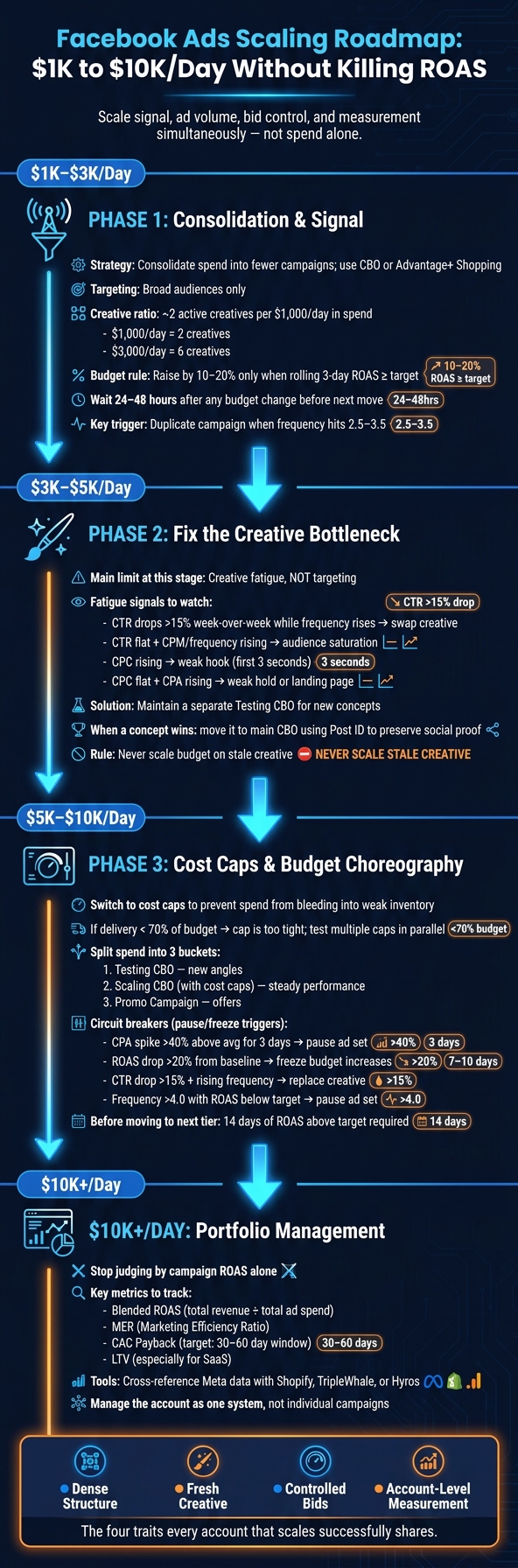
Facebook Ads Scaling Roadmap: $1K to $10K/Day Without Killing ROAS
Phase 1: $1,000 to $3,000 a day - consolidation and signal
Fewer campaigns, broader audiences, one scaling campaign
Phase 1 is about density, not expansion. Keep your spend packed into fewer places so Meta can read cleaner signal, faster.
Take the creatives that won in your testing ABO and move them into one scaling campaign using CBO or Advantage+ Shopping. Stick with broad targeting. The goal here is simple: don’t muddy the data.
A good rule of thumb is about two active creatives for every $1,000 in daily spend. That means:
- Two creatives at $1,000/day
- Six creatives at $3,000/day
That setup helps keep frequency from jumping too early, before the account has enough signal to support more spend.
Budget rules: when to raise, hold, or cut
My rule is pretty simple: only increase budget by 10%–20% when the rolling 3-day ROAS is at or above your target and the ad set is out of Meta’s learning phase.
After any budget change, wait at least 24–48 hours before making another move. If you keep poking the campaign too often, you risk throwing it back into learning.
Here’s the rule set:
| Condition | Action |
|---|---|
| ROAS ≥ target, frequency < 2.5, out of learning | Raise budget 10%–20%, wait 48–72 hours |
| ROAS ≥ target, frequency 2.5–3.5 | Duplicate before raising further |
| Ad set still in learning phase | Hold; don't touch budget |
| ROAS below target for 5+ days | Stop. Diagnose creative fatigue or audience saturation |
When to duplicate instead of raising budget in the same campaign
The default move is to increase budget inside the same campaign. That usually keeps signal cleaner and avoids splitting up your data.
Duplicate only when there’s a clear operating reason, like a new market, a new offer, a new attribution setup, or a separate bid strategy. And when you do duplicate, keep the Post ID so you preserve social proof.
You should also duplicate when frequency starts to climb and budget increases stop producing gains. If frequency goes up and CPA rises after spend increases, the problem usually isn’t budget. It’s the creative.
Phase 2: $3,000 to $5,000 a day - fixing the creative bottleneck
Once spend gets dense, the next limit usually isn't structure. It's creative.
At $3,000 to $5,000 per day, creative tends to wear out before targeting does. I see founders spend too much time tweaking interests and age ranges when the bigger issue is right in front of them: the ads are tired.
How to spot creative fatigue before ROAS collapses
You can usually see creative fatigue in the core metrics.
If CTR drops while CPM stays flat, the creative is the problem. If CTR stays flat but CPM and frequency go up, you're likely hitting saturation.
CPC helps you judge the hook. If CPC climbs, the first three seconds probably aren't doing their job. If CPC stays flat but CPA rises, the hook is doing fine, but the hold or the landing page is weak.
A simple kill rule works well here: if CTR falls by more than 15% week over week while frequency is rising, swap out the creative. And if an ad is trailing the rest of the test set after enough spend to judge the hook, pause it.
Build a creative pipeline that can support scale
At this spend level, the bottleneck is concept velocity, not small edits.
That's why I use ADEN'S LAB to keep new hooks, angles, and visual directions moving. That pipeline is what stops scale from stalling. When the flow of new concepts slows down, ROAS usually starts to drift lower even if targeting hasn't changed.
It can look like a targeting issue. Most of the time, it isn't. It's a creative throughput issue.
How to test and promote creatives without destabilizing the account
Use a separate testing CBO for new concepts only. Keep that lane small enough to learn from it without shaking up the main campaign.
When a concept wins, move it into the main CBO by Post ID to keep the social proof attached. That means the likes, comments, and shares carry over too, which can help performance hold up.
The rule I follow is simple: don't scale budget on stale creative. If the main campaign doesn't have a fresh winner rotating in, a budget bump just speeds up the slide.
Once the testing lane starts producing fresh winners again, you can move into cost caps and budget choreography. If fresh creative is keeping the account steady, the next limit is bid control, not added spend.
Phase 3: $5,000 to $10,000 a day - cost caps and budget choreography
Once the creative is stable, bid control usually becomes the next choke point. If the ads are still working, the next thing that limits growth is often how you manage bids. Simply bumping budgets up in a straight line tends to push spend into weaker inventory, and ROAS gets tougher to keep in line.
That’s why I switch to cost caps at this stage. They help keep spend efficient as budgets climb.
When and how to use cost caps
Cost caps make sense when you already have enough account history to know which bid level has produced results above your target ROAS. In the $5,000 to $10,000 a day range, I use them to cap CPA so ROAS stays within range.
A cost cap tells Meta to spend only when it believes it can hit your efficiency target. The tradeoff is simple: you get more control, but usually less volume.
I ran $1,011,172 through one cost-cap campaign at 3.90 ROAS. You can see that case study at this Black Friday breakdown.
If delivery drops below 70% of budget, the cap is too tight. At that point, I test a few caps in parallel ad sets to find the sweet spot between volume and efficiency.
Budget choreography: move dollars across campaigns instead of forcing one hero campaign
Once one cost cap is working, I don’t try to force a single campaign to take every extra dollar. That usually backfires.
Past $5,000 a day, I split spend into three buckets:
- a Testing CBO for new angles
- a Scaling CBO with cost caps for steadier performance
- a promo campaign for offers
Then I move dollars across those buckets based on rolling performance.
This setup keeps signal dense as spend goes up. If you try to make one campaign do all the heavy lifting, frequency gets squeezed, creative burns out faster, and the algorithm starts buying weaker inventory.
Protect ROAS with circuit breakers and 7- to 14-day checks
These are the triggers I use to stop damage early.
| Metric | Circuit Breaker Trigger | Action |
|---|---|---|
| CPA Spike | >40% above campaign avg for 3 days | Pause ad set |
| ROAS Drop | >20% decline from baseline | Freeze budget increases for 7–10 days |
| Creative Fatigue | >15% CTR drop + rising frequency | Replace creative |
| Frequency | >4.0 with ROAS below target | Pause ad set |
| Learning Phase | Learning phase still hasn't settled 7 days after an edit | Audit the learning-phase reset |
The 14-day check matters just as much. Before I move to the next spend tier, I want to see ROAS holding above target for at least 14 days.
At $10,000 a day, manage a portfolio - not individual campaigns
Once spend hits $10,000 a day, ad-level tweaks stop doing most of the heavy lifting. At that point, squeezing gains out of one campaign here and there isn't the main job anymore. What matters is account-level efficiency.
So the work changes. You're no longer just tuning single campaigns. You're managing the whole account like a portfolio.
Measure the whole account: blended ROAS, MER, CAC payback, and LTV
That’s why I don’t read an account through campaign ROAS alone. At this level of spend, I care more about blended ROAS - total revenue divided by total ad spend across the account - and MER, which shows how efficient the full paid system is.
For ecommerce, I check Meta’s reported numbers against Shopify and tools like TripleWhale or Hyros. At scale, Meta attribution and actual revenue almost never line up perfectly. That’s normal.
For SaaS, CAC payback and LTV matter more than campaign ROAS. A campaign can look weak on its own and still make sense inside the account. If the top-line numbers still work, I keep it running.
If CAC payback stays inside a sustainable 30- to 60-day window, I don’t shut off a campaign just because its standalone ROAS looks soft.
What the accounts that scale share four traits
At scale, the same four things keep working: dense structure, fresh creative, controlled bids, and account-level measurement.
That’s what system-level scaling looks like in practice. $239,000 in spend generated $1.98M in revenue at 8.27 ROAS. We also hit $544,397 in 72 hours during BFCM 2025 - full breakdown at the Black Friday case study.
Both results came from the same operating system: signal density, creative velocity, cost caps set from real data, and portfolio-level measurement holding it all together.
Scale comes from managing the account as one system, not from any single campaign.
Next, I’ll answer the questions that come up most often when brands push from $1,000 to $10,000 a day.