Meta Ads for SaaS: How I Took an AI SaaS From $15K to $150K a Month


This account did not grow because I made Meta ads more complex. It grew because I cut the noise. I moved the account from about $17,852 in December to $148,907 in May, while CPA fell from $139 to $131 and spend went up about 8x.
If your SaaS account is stuck, here’s the short version:
- I stopped optimizing for trial starts
- I switched tracking to CAPI
- I optimized for paid subscriptions
- I cut the account down to one main campaign
- I used cost caps to control CPA
- I kept ad output moving so frequency did not drag performance down
The main lesson is simple: Meta scales SaaS accounts better when it gets clean purchase data and enough volume in fewer places. Too many campaigns, weak event signals, and bad tracking usually slow the account down.
This case is a good reminder that if you want more paying users, you should build the account around revenue, not lead numbers that look good on paper.
The original numbers: the real estate AI SaaS Meta ads case study now includes every month of the export. December spend was $17,852.93; May was $148,907.37, or 8.34× as much. Purchase CPA fell $8.40, from $139.48 to $131.08. The $15K-to-$150K description is approximate. This is still an active client; the case page separates Meta purchases from subscription revenue and payback.
Connect account CPA to paid-customer economics
The spend and CPA in this case describe a specific account. For your own SaaS, compare matched trial cohorts with first payments and contribution payback. The trial-to-paid CAC guide walks through that calculation. For hands-on support at $15K+/month in spend, see Meta ads management for SaaS.
Why Most SaaS Meta Accounts Stall
SaaS accounts stall when the setup gives Meta too little signal to work with. In this case, the slowdown came from three leaks: segmentation, event choice, and attribution.
Too Much Segmentation Kills Signal
Most ad sets never get enough conversion volume to settle into a steady pattern. Budget gets split across too many campaigns and ad sets, and each one ends up too small to teach the system anything useful. Costs swing, delivery stays shaky, and Meta never gets a clear read on who is buying.
Put bluntly: you're running tests that never get enough runway to mean much.
The fix isn't more tinkering. It's fewer ad sets with enough budget behind them to learn.
The next issue is just as common: picking the wrong event.
Optimizing for Trials Usually Breaks the Account
This is the mistake I see most often in SaaS Meta accounts. The founder wants subscribers, so they optimize for trial starts because the numbers look better. And Meta does exactly what it's told to do. It finds people who start trials, not people who pay.
I don't optimize for micro-events. The only event that matters is the one tied to revenue. Match the optimization event to the money. Everything else is noise.
But even the right event falls apart if Meta can't see it cleanly.
Weak Tracking and Stale Creative Drive Bad Decisions
Poor tracking causes two problems at the same time: false winners and false losers. the real estate AI SaaS tool had a degraded revenue signal reaching Meta. Browser-side tracking misses a meaningful share of events because of ad blockers and iOS restrictions. That left Meta making budget calls on partial data, cutting campaigns that were working and pushing more spend into ones that weren't.
Without server-side tracking through CAPI, the algorithm couldn't see the full picture. And if it can't see the full picture, it can't steer toward the right customers.
Stale creative makes things worse. SaaS audiences are smaller, so frequency climbs fast. Once that happens, performance drops. People often blame the audience or the offer, but the real issue is creative fatigue. The fix is a steady flow of new creative.
What I Rebuilt in the Meta Account
I Rebuilt Tracking Around CAPI and Revenue Events
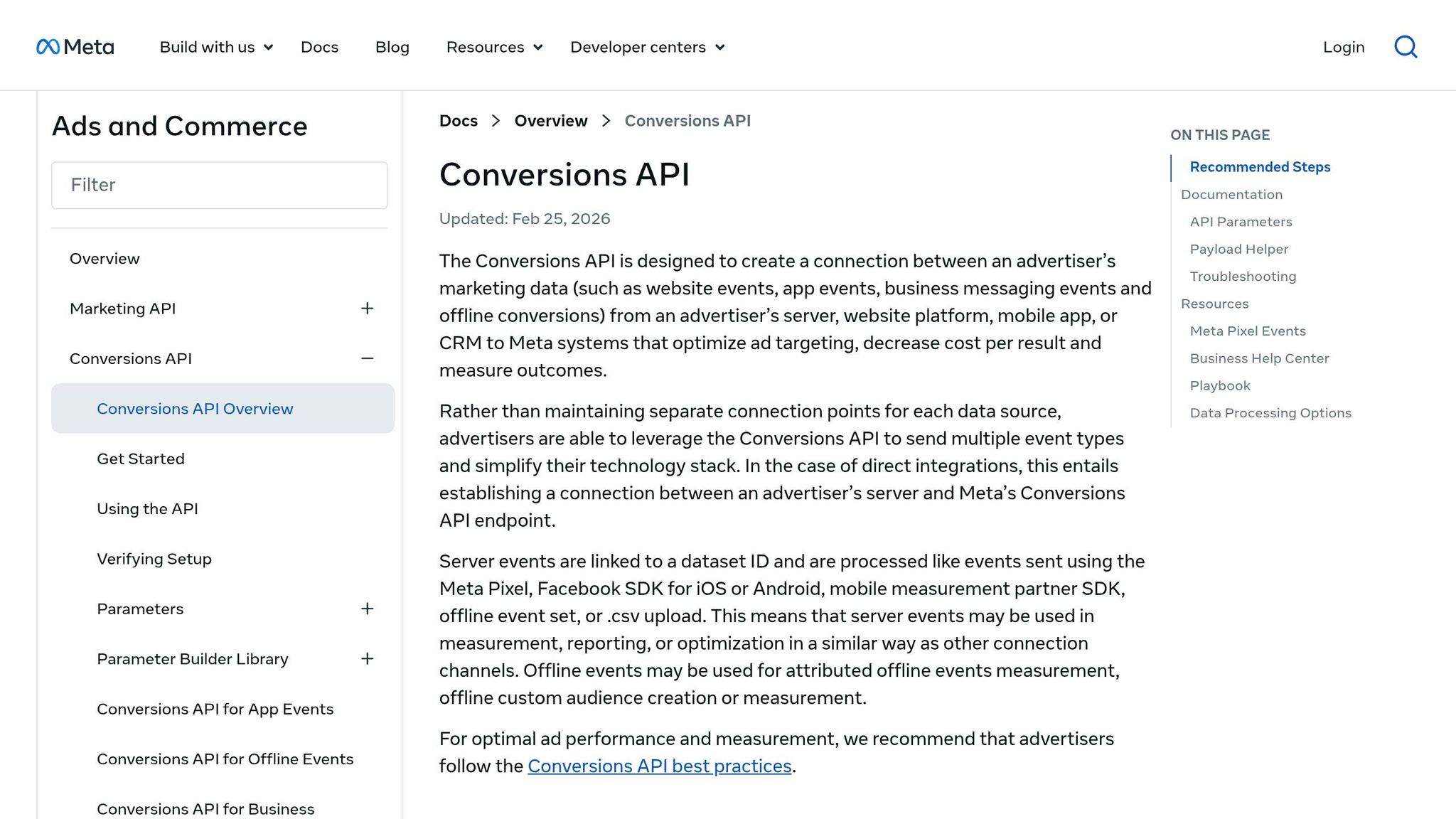
I started with tracking first.
I moved tracking to Meta Conversions API (CAPI) and mapped events straight from the billing stack. The point was simple: send Meta clean revenue data, not trial starts or other weak signals. When Meta sees who actually paid, it gets a much better shot at finding more people likely to pay.
Once that signal was in place, the rest of the account got easier to clean up.
I Simplified the Account and Optimized for One Conversion Event
I collapsed the setup into one prospecting campaign with a small retargeting layer.
There was one main conversion event: paid subscription. Not trial starts. Not pricing page visits. I tied optimization straight to revenue.
I also widened attribution to 28-day click so Meta could see the full path to purchase. the real estate AI SaaS tool had a trial period, and some trial-to-paid conversions were landing outside the default window.
With one event and cleaner attribution, scaling turned into a much simpler job. At that point, it came down to bids and creative.
I Used Cost Caps and Creative Volume to Scale Hard
I increased spend in jumps of 50% to 200% when the numbers supported it. Cost caps helped keep those jumps under control.
That was a big part of how the real estate AI SaaS tool moved from $17,852 in December at a $139 CPA to $148,907 in May at a $131 CPA. Spend went up by about 8x. CPA dropped.
I also kept creative output high with ADEN'S LAB, which has generated tens of thousands of creatives across accounts. New concepts kept moving through the system, so the account didn’t get stale as spend climbed.
That left me with four levers:
- Event quality
- Signal density
- Creative output
- Bid control
The SaaS Scaling Framework I Pulled from This Case
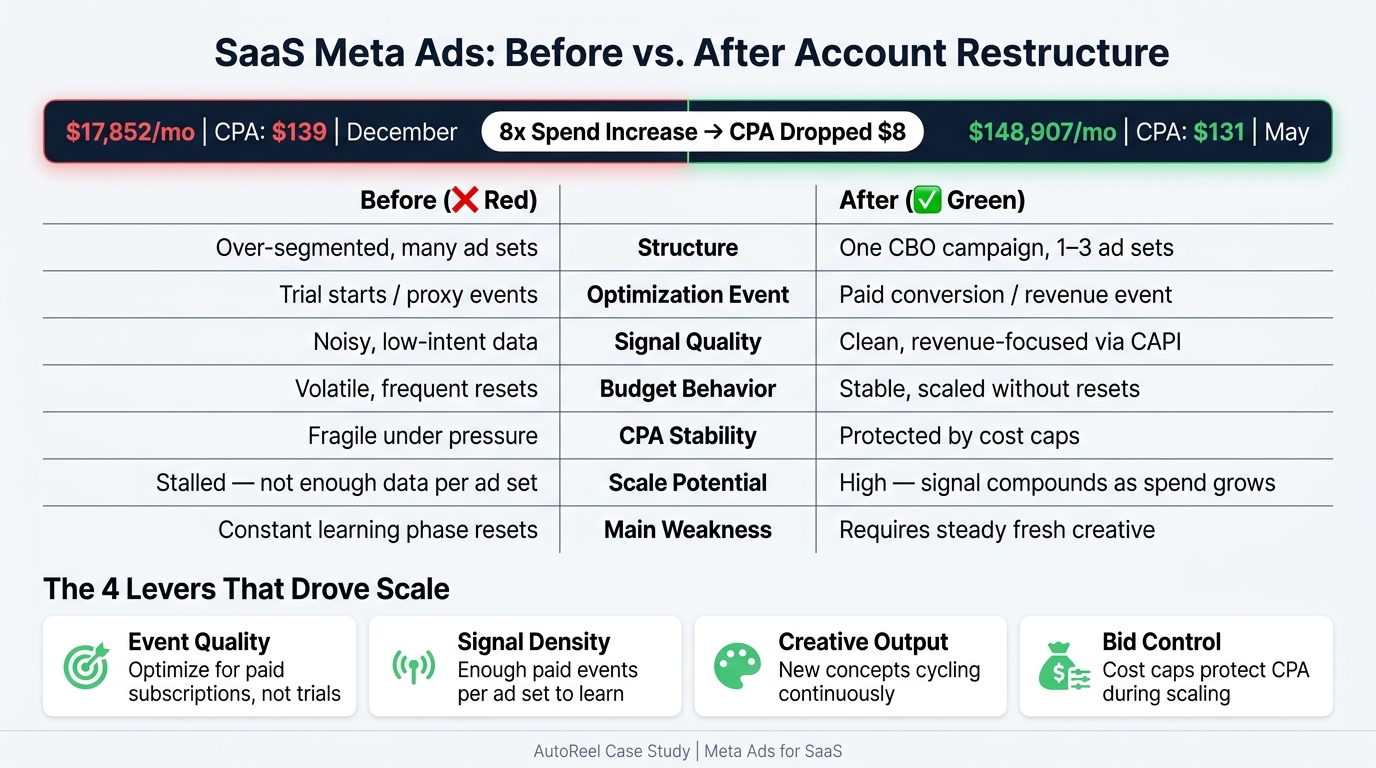
SaaS Meta Ads: Before vs. After Account Restructure ($17K to $148K)
Those were the four levers. The win came from using them together, not one at a time.
The 4 Levers I Used to Scale
These four levers stack on each other. If you pull one and ignore the rest, scale starts to fall apart.
Event quality: I optimized for paid subscriptions, not trials.
Signal density: I kept spend tight so Meta could learn from enough paid events. If an ad set can't drive enough paid conversions, I fold spend back in until it can learn.
Creative output: I kept new concepts cycling through the account so performance didn't go stale.
Bid control: I used cost caps to keep CPA in check while pushing budget harder.
Before vs. After: Account Structure Comparison
The before-and-after view makes the framework pretty clear.
| Dimension | Before | After |
|---|---|---|
| Structure | Over-segmented, many ad sets | One CBO campaign, 1–3 ad sets |
| Optimization Event | Trial starts / proxy events | Paid conversion / revenue event |
| Signal Quality | Noisy, low-intent data | Clean, revenue-focused via CAPI |
| Budget Behavior | Volatile, frequent resets | Stable, scaled without constant resets |
| CPA Stability | Fragile under pressure | Protected by cost caps |
| Scale Potential | Stalled - not enough data per ad set | High - signal compounds as spend grows |
| Main Weakness | Learning phase resets constantly | Stops working without fresh creative. |
The old setup kept kicking the account back into learning, which made it hard to build momentum.
The Numbers That Mattered: December to May
Once those four levers lined up, the numbers changed.
From December to May, the real estate AI SaaS tool went from $17,852 at a $139 CPA to $148,907 at a $131 CPA. Spend increased 8x while CPA dropped by $8.
The full breakdown of how I rebuilt this account is at /work/real-estate-ai-saas-tool.
Conclusion: What SaaS Founders Should Take from This
The lesson from the real estate AI SaaS tool is pretty simple: the account grew when I fixed the system, not when I kept chasing random tactics.
the real estate AI SaaS tool went from $17,852 to $148,907 in six months, while CPA dropped from $139 to $131. That tells you a lot. The sequence matters. First, fix tracking. Then use one real revenue event. Cut down the ad sets. Bring in new creative. After that, scale hard.
When tracking is weak and event volume is low, the account starts learning from messy signals instead of actual purchases. And that’s where things go sideways.
Each part leans on the next. If one breaks, scale slows down. Fixing just one variable won’t grow the account by itself. Meta tends to scale SaaS accounts when it can clearly read revenue, get enough conversion volume, and keep seeing new creative on a steady basis.
That same discipline showed up in my Black Friday work. For cost-cap discipline under pressure, read the Black Friday case study.
If your account is stuck, see my services.
Book a 30-minute strategy call - direct with me, and you leave with a clear diagnosis.
FAQs
When should a SaaS account optimize for paid subscriptions instead of trials?
A SaaS account should optimize for paid subscriptions instead of trials when the trial-to-paid conversion rate is high enough to make the final purchase event the better target.
A simple rule of thumb: once you have enough volume - usually 50+ conversions per week - you can optimize with confidence for the purchase or start trial event.
How many paid conversions does Meta need before a SaaS campaign can scale?
Meta usually needs around 50 conversion events per ad set each week to exit the learning phase.
So before you scale, a SaaS campaign should usually be getting about 50 paid conversions per week for each ad set.
How do cost caps work when scaling Meta ads for SaaS?
Cost caps let you scale with a target CPA in place. As you increase budget, Meta works to keep acquisition costs at or below that number.
Once performance settles down, you can increase budgets bit by bit and watch CPA closely. Automated rules can pause or adjust ad sets if CPA moves above your target, which helps protect efficiency while you scale hard.
Continue with a focused diagnosis
Use these guides when the next decision needs a more specific worksheet or investigation.