Meta Ads Cost Cap Bidding: The Complete Scaling Guide (I Put $1M Through One Campaign)


Cost cap is for scaling spend while keeping CPA in line. In this case, I put $1,011,172 through one Meta campaign and held 3.90 ROAS across 135 million impressions by using cost cap the right way.
If you want the short version, here it is:
- I use Highest Volume first, then switch to Cost Cap after CPA is steady
- I set the first cap 10%–20% above the last 7–14 days of stable CPA
- I don’t use cost cap on low-volume or unproven offers
- I scale budget in small steps, usually 8%–20%, then wait 72 hours to 7 days
- If spend stalls, the cap is often too tight
- If performance slips at scale, ad supply, audience saturation, or frequency is often the issue
This piece also explains when Bid Cap or Minimum ROAS makes more sense, how I tie caps to margin, LTV, and payback window, and how I rotate ads without hurting delivery.
For an acquisition-focused application of cost caps, see my US DTC jewelry case study: about $148K more total sales and new-customer CPA down 22.42%, while all-channel ad spend fell 2.58%. I tested different caps with high campaign budgets, consolidated winners, and kept fresh creative launching. The jewelry account management breakdown explains how those decisions worked together and includes all three original screenshots. Those results cover that account and comparison window; they are not a universal cap-setting recipe.
Cost caps in my SaaS and BFCM accounts
In my real estate AI SaaS account, monthly Meta spend went from $17,852.93 in December 2025 to $148,907.37 in May 2026. Purchase CPA finished at $131.08, down from $139.48. I rebuilt the campaign structure and CAPI, supplied fresh creative, and tested cost caps against high campaign budgets. The case includes the original six-month export and a month-by-month spend and purchase CPA table.
For one US ecommerce jewelry brand during BFCM, I managed $544,397.42 in Meta spend. The export covers November 28–December 1, 2025 and reports 32,527,317 impressions and 10,803,882 reach. I prepared the creative in October, staged budgets, and made scale-or-cut decisions throughout the run. Open the case to see the original export and the account work.
Check the economics before changing the cap
A cost cap is an average-cost goal, not a guarantee that every conversion costs less than the number entered. A bid cap limits an auction bid; it does not guarantee a per-customer CPA either. The pacing percentages and thresholds in this guide are account-planning heuristics, not universal Meta requirements.
Use the free break-even CPA and ROAS calculator to work backward from ecommerce contribution. Then compare that ceiling with a representative observed acquisition cost. If the account cannot acquire customers within the business constraint, a tighter cap alone will not fix the offer, conversion path, or creative.
For businesses spending $15K+/month, the Meta ads account audit connects those decisions to tracking and funnel evidence. SaaS teams should also check trial-to-paid CAC rather than judging scale on trial cost alone.
Quick Comparison
| Bid strategy | Best for | Main tradeoff |
|---|---|---|
| Highest Volume | New campaigns and finding baseline CPA | CPA can drift as spend grows |
| Cost Cap | Scaling a proven funnel with CPA control | Delivery can stall if the cap is too low |
| Bid Cap | Cases requiring an auction-bid ceiling | Low delivery and less room to scale |
| Minimum ROAS | Stores with big swings in order value | Needs clean value tracking |
The main idea is simple: cost cap is not a hard stop per conversion. It is an average CPA target. If you already have volume, margin data, and a stable CPA, Meta Ads management can help you spend more without letting acquisition costs run loose.
Where Cost Cap Fits Among Meta Bid Strategies

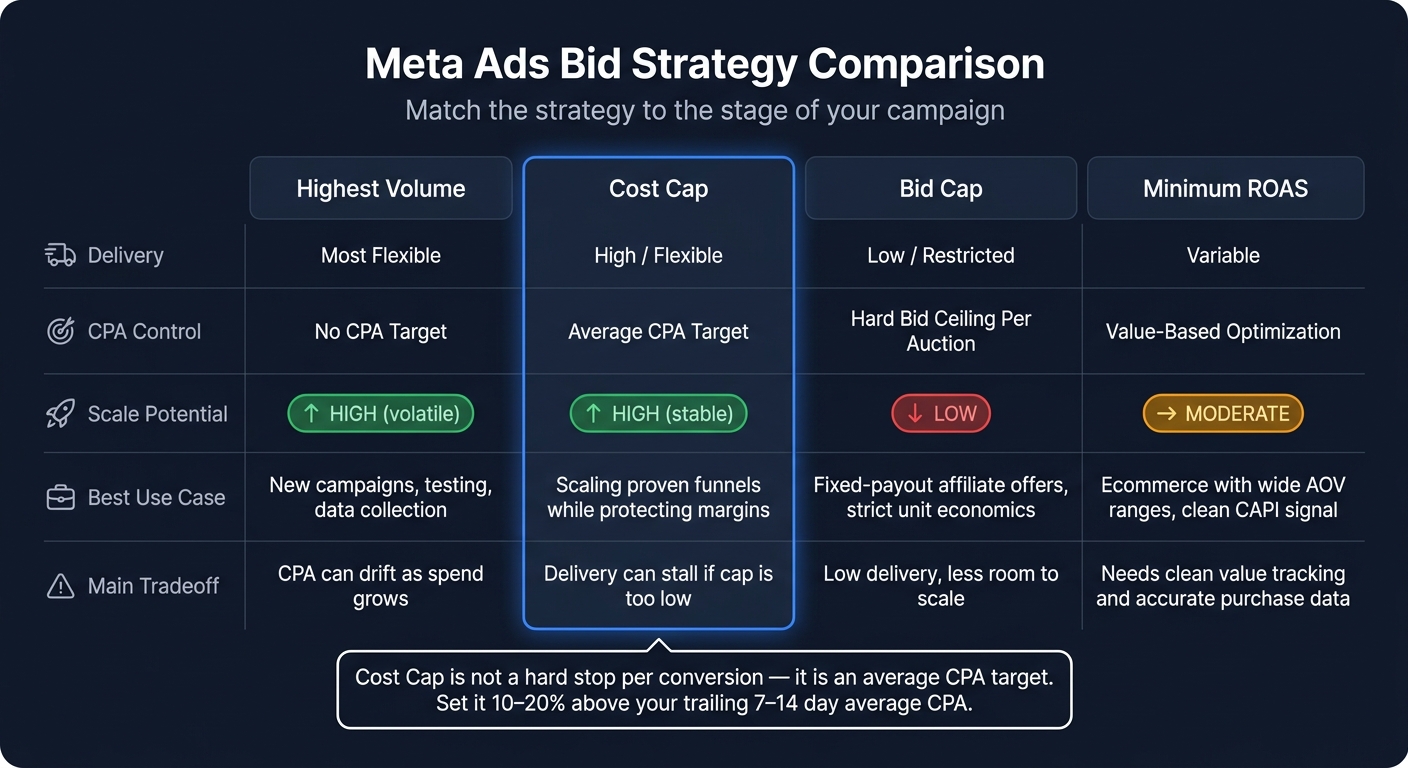
Meta Ads Bid Strategy Comparison: Cost Cap vs Highest Volume vs Bid Cap vs Minimum ROAS
Here’s where cost cap sits next to Meta’s other bid strategies.
The main idea is simple: match the bid strategy to the stage of the campaign. Each option does a different job.
| Strategy | Delivery | CPA Control | Scale Potential | Best Use Case |
|---|---|---|---|---|
| Highest Volume | Most flexible | No CPA target | High, volatile | New campaigns, testing, and data collection |
| Cost Cap | High / Flexible | Average CPA target | High | Scaling proven funnels while protecting margins |
| Bid Cap | Low / Restricted | Hard bid ceiling per auction | Low | Direct control over the maximum auction bid; no per-conversion cost guarantee |
| Minimum ROAS | Variable | Value-based optimization | Moderate | Ecommerce with wide AOV ranges and clean CAPI signal |
Cost Cap vs Highest Volume
I start with Highest Volume.
It gives Meta the most room to spend budget and hunt for conversions as cheaply as the market allows. There are no constraints, which makes it the right move when I’m still trying to find a baseline CPA.
The tradeoff is pretty clear: Highest Volume has no CPA ceiling. When you push budget up, CPA can start to drift. Once conversion volume is steady and you have a recent CPA baseline, cost cap becomes the better fit.
Why? Because cost cap keeps the average acquisition cost anchored while still giving Meta room to grow spend. Highest Volume finds the floor. Cost cap helps hold it.
That’s why I start with Highest Volume, then shift to cost cap after CPA settles down.
Cost Cap vs Bid Cap
This is the comparison people get wrong most often.
Cost cap manages your average CPA over time. Meta can bid more aggressively in one auction if the average CPA still stays in line.
Bid cap works differently. It puts a hard ceiling on each auction bid. Meta won’t go above that number, even when an auction looks like a strong opportunity.
That lack of flexibility is why bid cap usually struggles to scale. If the cap is too tight, delivery often dries up. I almost never use bid cap for growth campaigns.
I keep it for narrow setups, like fixed-payout affiliate offers, where every conversion has to stay under a hard number and volume matters less.
For growth campaigns, I almost always want flexibility instead of a hard ceiling on every auction.
When Minimum ROAS Is the Better Choice
If your product catalog has a wide spread in price, Minimum ROAS can make more sense than cost cap.
Instead of pushing Meta to find cheaper conversions, it tells the system to go after higher-value purchases. That matters a lot when one sale might be worth far more than another. For single-price offers, cost cap is usually the cleaner choice.
There’s one catch: Minimum ROAS needs clean data. Value optimization only works if your purchase value data is accurate and your CAPI signal is clean.
Use it when value matters more than raw CPA.
How to Set Your First Cost Cap From Real Numbers
Once the bid strategy is in place, your first cap needs to match what the account can actually buy right now.
I don’t set the first cost cap at the CPA I want. I set it based on the CPA the account can support today.
Start With Target CPA, Margin, and Payback Window
Ecommerce and SaaS don’t use the same math.
For ecommerce, I start with gross margin, repeat purchase rate, and payback window. If I can break even on the first order and make money on repeat orders, the cap can be set higher. If the business needs profit on the first order, the cap has to leave room for fulfillment, returns, and payment fees.
For SaaS, I work backward from LTV and payback window. If LTV stretches far enough, the cap can sit above day-one profit. If the business needs cash back faster, the cap needs to come down.
Ecommerce caps follow margin and payback. SaaS caps follow LTV and payback. That gives you the ceiling. Then you anchor that number to current CPA.
Set the First Cap Slightly Above Your Recent Stable CPA
I only make the switch after Highest Volume gives me a stable CPA baseline. That means waiting for enough recent conversion volume to trust the number.
Then I set the first cap slightly above the trailing 7–14 day average CPA, not directly at that CPA. If my stable CPA is $85, I start a bit higher than $85.
That buffer matters. Meta can pay more for one conversion and still keep the average in line. That’s why I put the cap above the recent average. If I place it right on top of the current average, delivery often dries up.
Why Campaigns Die When the Cap Is Wrong
This is the pattern I see most often. Founders set the cap at their goal CPA instead of the market-clearing CPA. Spend slows down. Impressions drop close to zero. Ads Manager may show "Limited by bid strategy." It can also show "Learning Limited" when the ad set can’t gather enough signal to settle down.
Raising budget doesn’t fix a cap problem. If the cap is too low, Meta just can’t find enough auctions at that price. A bad cap doesn’t only hurt efficiency. It blocks scale. Cost cap is a scaling governor, not a brake, and when the cap is too tight, it becomes a wall.
There’s a second failure mode too. The campaign spends, but it gets stuck in a smaller, overexposed audience pocket. ROAS slips and efficiency drops.
When that happens, I loosen the cap first. I let spend settle. Then I tighten it little by little. After that, the next issue is budget ramp.
My Cost Cap Scaling System: Structure, Ramp, and Budget
Once the cap is set, the hard part starts: structure and pacing.
When to Switch From Highest Volume to Cost Cap
I don't switch to cost cap to chase lower CPAs. I switch when the account is steady.
Before I move a campaign from Highest Volume to cost cap, four things need to be in place. The offer has to be proven, with repeatable sales, not a one-off spike. The ad set needs to generate at least 50 conversions per week. ROAS needs to stay within 20% of target for at least 14 straight days. And tracking has to be clean: Meta Pixel firing the right way, Conversions API connected, and purchase signals coming through without noise.
That last part gets overlooked all the time. If the data is messy, I don't trust cost cap.
Once those four boxes are checked, I move to structure.
Campaign Structure and Ramp Method
I keep prospecting and remarketing in separate campaigns. I use one bid strategy per campaign. And I usually stay within 2–5 ad sets per campaign. Simple setup keeps the learning signal tight enough for cost cap to do its job.
I also don't increase daily budget by more than 20% at once, and I wait at least 72 hours before making another budget change. Bigger jumps can reset the learning phase, and that can lead to 3–7 days of shaky performance. At higher spend levels, I move even slower.
| Monthly Spend Tier | Max Daily Budget Increase | Wait Period |
|---|---|---|
| $5K–$15K/mo | 20% | 72 hours |
| $15K–$30K/mo | 15% | 72 hours |
| $30K–$75K/mo | 10% | 96 hours |
| $75K+/mo | 8% (or $500 max) | 5–7 days |
I change one major variable at a time. If I adjust budget, I leave the cap alone. If I rotate creative, I don't bump budget that same day. Stack changes, and now you're guessing. Was it the budget? The cap? The new ad? That's how people lose the plot.
The published campaign evidence records $1,011,172 in spend and 3.90 ROAS. The screenshot alone does not establish every historical setting or isolate the effect of a bid strategy. See the campaign evidence.
After budget, the next bottleneck is creative supply.
How Budget and Cost Cap Work Together
Budget controls spend. Cost cap controls the auction price. When the cap is set well, more budget can drive more volume. When the cap is too low, adding budget doesn't do much. Spend just stalls.
At higher spend levels, I use one move a lot: I set a high daily budget ceiling, sometimes $10,000+, and let the cost cap act like the governor. That gives the campaign room to push on strong days without me stepping in to change spend by hand. When inventory gets expensive, the cap helps keep spend under control.
Before I touch spend, I check Meta, Shopify, and one attribution source. If creative supply is weak, I stop pushing budget.
Creative Supply, Optimization Rules, and Final Takeaways
Why Creative Quality Matters More Inside Capped Campaigns
Once you set the cap, creative becomes the bottleneck.
With a cost cap in place, Meta has less room to win auctions at lower prices. If your creative can't hold up in the auction, delivery slows down. Weak ads don't just perform poorly. They often get starved of spend.
Pay close attention to CTR, CPM, spend pace, and frequency. If an ad set is spending less than 70% of its daily budget, the cap is likely too tight. If CTR starts dropping, that's usually a sign of creative fatigue. If CPM climbs while CTR stays flat, you're likely dealing with audience saturation.
Once frequency goes past 3.0 on core segments, the cheaper inventory is usually gone. At that point, you have three levers:
- Raise the cap
- Broaden the audience
- Rotate in new creative
How to Rotate Creative Without Breaking Delivery
When delivery gets tighter, creative rotation needs to protect the signal instead of wiping the slate clean.
Batch your updates. Make one round of changes, then wait 48–72 hours before judging the result or changing anything else. If a creative starts to fade, duplicate the winning ad set and test a new angle in the copy. Don't touch the live winner. That way, the winner keeps running while the new angle builds its own data.
Keep 3–5 angles ready at all times. If you're spending $100,000+/month, keep 8–15 in reserve.
That's what scale looks like when creative supply stays ahead of spend. The anonymous real estate AI SaaS account went from $15,000 to $150,000 per month in 6 months, while CPA dropped by $8. You can see the full breakdown at the real estate AI SaaS tool.
The 5 Rules I Follow With Meta Ads Cost Cap
- Validate before you cap. Cost cap works best for proven offers with at least 50 optimization events in 7 days.
- Set the cap from real numbers. Start 10–20% above your trailing 7–14 day average CPA.
- Don't tighten fast. Lower caps in small steps and wait 72–96 hours between changes.
- Budget is volume. Cap is control. A bigger budget with a strong cap gives Meta room to scale without letting CPA drift.
- Creative has to earn the spend. The cap sets the ceiling. Creative supply decides whether Meta can win auctions at that price.
FAQs
When should I switch from Highest Volume to cost cap?
Switch from Highest Volume to Cost Cap once you have a stable baseline CPA - usually after at least 50 conversions. At that point, the campaign is often out of learning, and the goal shifts to getting more predictable costs as you scale.
A solid starting point is a Cost Cap set 10–20% above your proven average CPA. If you make the switch too early, delivery can get tighter and performance can drop.
How do I know if my cost cap is too low?
Your cost cap is probably set too low if delivery falls off a cliff - spend drops, impressions dry up, or the ad set stops spending altogether. In plain English, Meta likely can’t find enough auctions at that price point.
This tends to happen when your cap sits below your recent 7–14 day average CPA.
Here’s a simple way to check it: if delivery slows down or stops even though conversions are still coming in, increase the cap by 10–20% and see if spend starts to recover.
Should I use cost cap for e-commerce or SaaS?
Usually, Cost Cap works for both.
For e-commerce, it helps keep CPA more predictable while still giving Meta some room to find volume. For SaaS, it can work well too when cost control matters and you want steadier CPLs.
Use it once you have enough conversion data and your CPA is stable. Set the cap at your target CPA or a bit above it.
ROAS Target may make more sense for SaaS if lifetime value is high or AOV varies a lot.
Continue with a focused diagnosis
Use these guides when the next decision needs a more specific worksheet or investigation.