Freelance Media Buyer vs Agency vs In-House: What $100M of Spend Taught Me

If you’re spending more than $10,000 a month on Meta, the hiring model matters almost as much as the ads. From more than $100 million in spend across 60+ brands, I’ve seen the same pattern: freelancers hit a capacity wall, agencies lose speed through handoffs, and in-house hires put too much in one person.
Here’s the short version:
- Freelance media buyer: low cost, direct access, limited bandwidth
- Agency: more people, more layers, slower communication
- In-house: best context, highest payroll, high turnover risk
- Operator + AI stack: one owner across buying, testing, copy, and tracking, with fewer handoffs
If you run ecommerce at $50,000 to $2,000,000 a month or SaaS already spending on Meta, your main issue usually isn’t setup anymore. It’s:
- ad output
- budget control
- tracking you can trust
That’s why the right choice depends less on preference and more on your bottleneck:
- At $10,000 to $30,000/month, a freelancer often fits best
- At $30,000 to $150,000/month, structure and testing speed matter more than team size
- At $150,000+/month, in-house starts to make more sense, but usually not alone
If you are considering an operator with an AI production system, my AI operator versus agency breakdown maps media buying, creative, landing pages and tracking to a clear scope, with my current fee and original account evidence.
Quick Comparison
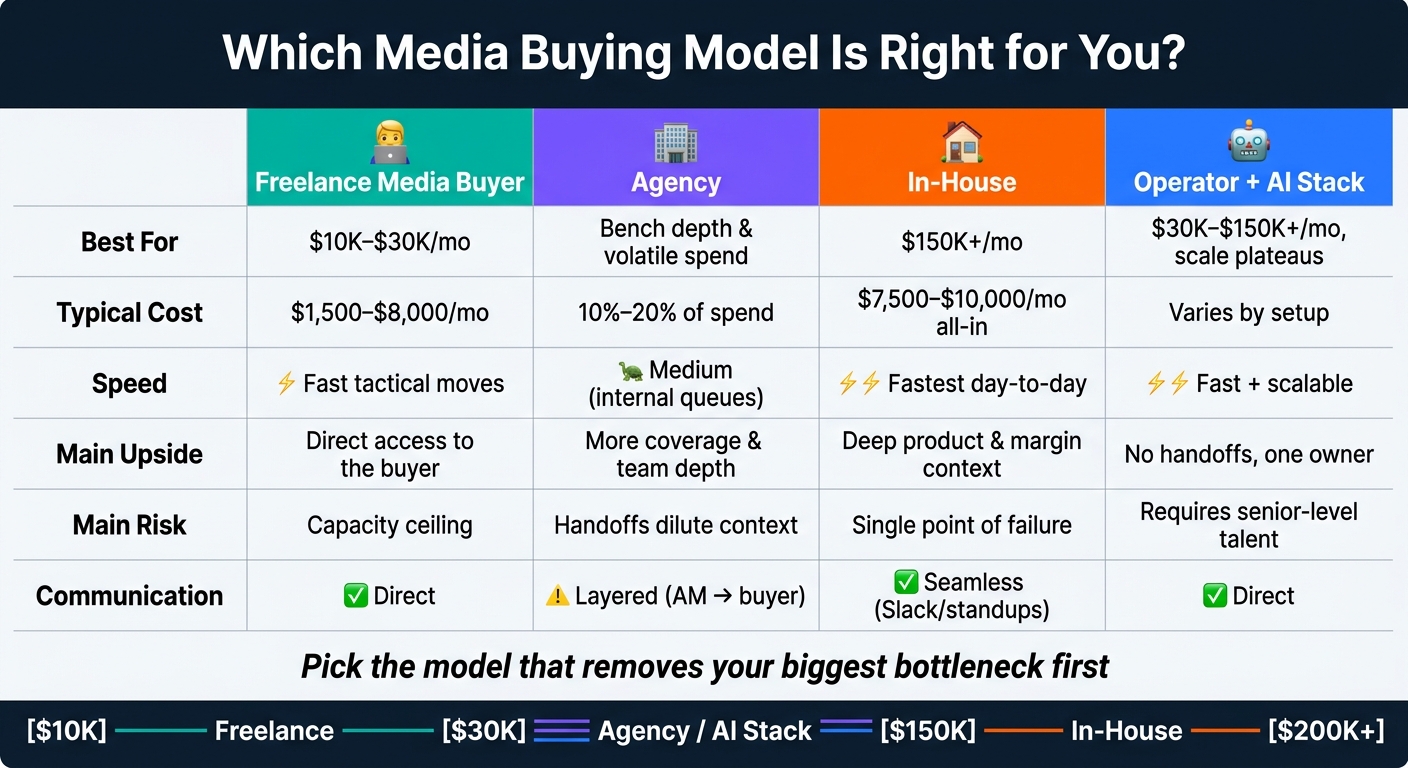
Freelance vs Agency vs In-House vs AI Stack: Media Buyer Comparison
| Model | Best for | Main upside | Main downside | Typical cost |
|---|---|---|---|---|
| Freelance media buyer | Brands at $10K–$30K/month | Direct contact with the person running ads | One-person capacity limit | $1,500–$8,000/month |
| Agency | Brands that need more team support | More coverage during busy periods | More handoffs, less direct control | 10%–20% of spend or flat fee |
| In-house | Brands at $150K+/month | Deep product, margin, and team context | One hire can become a single failure point | $7,500–$10,000/month all-in |
| Operator + AI stack | Brands blocked by testing speed or slow execution | One owner, fewer layers, more output | Depends on high-level skill in one seat | Varies by setup |
My view is simple: pick the structure that removes your biggest problem first - bandwidth, handoffs, or internal context. That’s the frame for the rest of this piece.
Freelance media buyer vs agency vs in-house: the real trade-offs
Each setup fixes one problem and creates another.
At higher spend levels, the three constraints that matter most - creative, budget, and tracking - tend to break in different ways based on how the work is set up.
| Dimension | Freelance Media Buyer | Agency | In-House |
|---|---|---|---|
| Cost | Lowest fixed cost; $1,500–$8,000/mo retainer | Mid-to-high; 10%–20% of spend or a flat retainer | Highest; roughly $7,500–$10,000/mo all-in |
| Speed | Fast tactical moves; capped by one person | Medium; internal queues slow creative cycles | Fastest day to day; no briefing lag |
| Creative Control | Limited; usually needs founder input | Variable; goes through an internal production queue | Highest; deep product and brand context |
| Tracking Ownership | Variable; depends on one person's technical depth | High; team shares tools and expertise | Deep; direct access to internal data |
| Communication Path | Direct; you talk to the person in Ads Manager | Layered; founder → account manager → buyer | Seamless; lives in Slack and standups |
| Failure Risk | Single point of failure if overloaded or unavailable | Attention dilution; junior staff on smaller accounts | Knowledge walks out the door if they leave |
So the issue isn't which model looks best in a pitch deck. It's which downside you can handle without the account falling apart.
Freelance media buyer: direct access, limited bandwidth
The upside is pretty obvious: you work with the person who is actually inside Ads Manager. If you need to move budget, swap creative, or change a cost cap, that can happen fast.
But the limit is just as obvious. One person only has so many hours in a week. If they're running several accounts and your brand heats up during peak season, you won't be the only fire to deal with. If they get sick, burn out, or land a larger client, your account can go quiet.
That isn't a shot at freelancers. It's just the math of a solo operator.
Agency: more resources, more handoffs
The pitch is senior. The day-to-day work usually isn't.
In a lot of cases, your main point of contact is a junior account manager passing notes between you and the buyer. That adds friction fast. Context gets watered down on both ends, and small details start slipping through the cracks.
The core problem here isn't lack of effort. It's dilution. Smaller accounts usually don't get senior eyes. Creative cycles drag because production moves through an internal queue. Then there's turnover: account manager churn averages every 12 to 18 months. Right when someone starts to understand your business, you're briefing a new person all over again.
That said, agencies do have one clear edge: bench depth. When spend moves hard, a team can absorb that change better than one person working alone.
In-house: full context, high concentration risk
An in-house buyer knows the product, margins, inventory calendar, and internal Slack threads. That level of context is hard to match from the outside. If a new offer launches or a landing page changes, they usually hear about it first.
The catch is concentration risk. Founders often try to pack media buying, creative, analytics, and CRO into one role. That's too much for one seat. And when that person leaves, a lot leaves with them. New hires often need 3–6 months to get to full output.
That's the trade-off. You get context and speed, but you also put a lot of the system inside one person's head.
Those trade-offs are exactly why I moved to an operator-plus-AI stack. The weak points in these three models are the same ones the fourth model is built to fix.
The fourth model: operator plus AI stack
The first three models break down in different ways. This one is built to cut out those weak spots.
This is not just a better freelancer setup. It is a different way to run the work. One operator owns strategy, execution, creative, tracking, and the testing roadmap, with no handoffs anywhere in the chain.
What lets this model grow is the AI layer. Creative briefs, copy variants, angle research, and performance review can all be handled by AI at a volume that used to need a full team. That gives the operator room to focus on judgment: what to test next, what to keep, and what to cut.
This model removes handoffs, not just headcount.
Why this model cuts the usual bottlenecks
Agencies tend to slow things down. Freelancers run into bandwidth limits. In-house teams can get stuck looking at the same problems the same way.
AI shrinks the time spent on research and synthesis. The operator stays focused on strategy while the stack handles production volume.
That is why this model acts differently once spend starts climbing.
Proof from real accounts I managed
the real estate AI SaaS tool started at $15,000/month in Meta spend. Six months later, it reached $150,000/month, with CPA down by $8. The lift came from a faster testing loop. Full breakdown at /work/real-estate-ai-saas-tool.
Who this model fits and who it does not
This setup works for brands that already have a proven offer and enough volume to test at speed. You need to be ready to move fast:
- test new creative angles quickly
- iterate landing pages based on live data
- adjust offers when the numbers tell you to
If that feedback loop is missing on your side, the model stalls.
It is not built for brands that are still trying to find product-market fit.
The next question is which structure fits your spend level and team shape.
How to choose based on spend level and team structure
Choose based on the bottleneck: bandwidth, speed, or integration.
Then use your spend level to figure out which problem you need to fix first.
I don't pick a model based on preference. I pick it based on the bottleneck.
Here's how I'd think about it at each spend level.
$10,000 to $30,000/month in spend
At this range, a senior in-house hire usually doesn't make financial sense. The all-in cost is about $7,500 to $10,000/month when spend is still too low to carry a full-time salary.
A strong freelancer can work well here, especially if you already have founder-led strategy and some basic creative in place. The main risk is testing volume. If you aren't shipping enough new creative angles each month, things start to wobble.
At this stage, speed matters less than clean execution and enough testing volume.
$30,000 to $150,000/month in spend
This is where structure matters more than raw talent. Agency fees at 10% to 20% of spend can land between $3,000 and $30,000/month. You're paying for more hands on deck, but handoffs can slow down the very speed you thought you were buying.
This is also the range where the operator + AI stack model often makes the most sense when the main issue is creative velocity or a scale plateau. One operator owning strategy, execution, and testing - backed by AI for trafficking, reporting, and spend pacing - will often move faster than an agency setup with too many handoffs.
That's where the fourth model starts to beat the usual setup.
$150,000/month and up
In-house becomes more realistic at this scale. Tight connection with finance and inventory is hard to pull off from the outside. An in-house operator can react to a margin shift or stock constraint in real time.
That said, one in-house hire rarely covers strategy, data analysis, media buying, copywriting, and design all at once. Most brands still need specialist support for creative volume and busy periods.
At every level, own your Meta Business Manager, ad accounts, GA4, and GTM. Keep first-party data in your own system. Account ownership can make or break a transition.
Conclusion: pick the structure that fixes your bottleneck
At this point, the question isn’t which model is best. It’s which bottleneck you need to remove first.
Pick the model that clears your biggest constraint: bandwidth, handoffs, or context.
If you need senior execution without extra layers, a freelance media buyer can be a good fit. If you need bench depth and can handle the handoffs, an agency makes sense. If you’re at $150,000/month+ and need deep product context plus data control, in-house starts to make more sense.
The operator + AI stack is the model I run. One operator owns strategy, execution, and testing, with no handoffs anywhere in the chain. It’s not a freelancer model or an agency model. It’s backed by ADEN'S LAB.
Key takeaways
Here’s the shortest way to choose.
| Model | Best fit | Limit |
|---|---|---|
| Freelance media buyer | $10K–$30K/mo, senior execution | Capacity ceiling |
| Agency | Bench depth, volatile spend | Handoffs |
| In-House | $150K+/mo, deep product context and data control | Single point of failure |
| Operator + AI stack | Fast creative output, direct accountability | Requires senior-level talent |
If you want the structure I use, the next step is simple. Book a 30-minute strategy call - direct with me, you leave with a diagnosis either way.
FAQs
How do I know which bottleneck is actually holding Meta performance back?
Diagnose where performance starts to fall apart: creative quality, audience targeting, technical setup, or account management.
If spend is high but results are lagging, weak signal quality can throw Meta’s learning and optimization off track. That often happens when CAPI is misconfigured or pixel data has degraded. In plain English, Meta stops getting clean feedback, and the system has a harder time finding the right people.
Another common problem is creative fatigue or weak audience segmentation. Start by checking:
- Creative rotation
- Signal quality
- Audience setup
- Management practices
If those pieces look solid, the bottleneck is more likely campaign structure or bidding.
When should I move from a freelancer to in-house or another setup?
Consider it when your freelancer starts slowing things down, which often happens once ad spend climbs past $50,000/month. At that point, the job usually gets bigger: more moving parts, more complexity, and a stronger need for someone who can own strategy, data, and creative from end to end.
It can also be the right move if you're entering new markets or want tighter control over the account. If you do make the switch, plan for a 60–90 day overlap so knowledge can transfer cleanly and performance doesn't dip.
Can one operator really handle buying, testing, tracking, and creative at scale?
Yes - one operator can handle buying, testing, tracking, and creative at scale. But the short answer is: it depends on the setup.
For smaller or less complex campaigns, one skilled operator with the right AI stack can do the job well. They can manage media buying, run tests, watch performance, and keep creative moving without too much friction.
Once the account gets bigger, though, things can get messy. More spend usually means more moving parts, more checks, and more room for small mistakes to slip through. That can lead to bottlenecks, ad fatigue, or details getting missed.
That’s why a hybrid model or a more specialized team often works better at larger scale. One person can still own the system, but extra support tends to help when volume climbs.