Why Your Facebook Ads CPA Goes Up When You Scale (And the Fix)


If your Meta CPA goes up when you scale, that does not mean the account is broken. In most cases, Meta spent the easy conversions first, then had to push into lower-intent users, pricier auctions, and weaker ad response. The fix is simple: scale in small steps, keep account structure tight, use cost caps once you have enough data, and swap ads before performance slips.
Here’s the short version:
- More spend usually means harder conversions
- Big budget jumps can reset learning for 3 to 7 days
- High frequency often leads to weaker click-through rate and higher CPC
- Too many ad sets split data and keep delivery unstable
- Ad fatigue shows up fast at higher spend
- Attribution lag can make today’s CPA look worse than it is
- A clean setup can still scale
Before you push budget, I’d check five things from the last 7 to 14 days:
- CPA trend
- CTR
- Frequency
- Conversion volume
- Ad pipeline
If one of those is off, I’d fix that first instead of forcing more spend.
| Check | Bad sign | What I’d do |
|---|---|---|
| CPA trend | More than 15% up week over week | Stop scaling and find the weak spot |
| CTR | More than 25% below the first-week baseline | Change hook, angle, or format |
| Frequency | Above 3.5 on prospecting in 7 days | Rotate ads or open up audience |
| Conversion volume | Under 50 optimization events per week | Merge ad sets and cut overlap |
| Ad backup | Fewer than 3 to 5 backup ads ready | Build new ads before scaling |
That’s the core point: CPA goes up during scale when spend outruns signal, audience depth, or ad performance. If you control those three, you give the account a much better shot at holding efficiency as budget grows.
The scaling mistakes that break CPA fast
The bigger issue is usually the account, not the market. If auction depth explains why CPA starts slipping, these are the mistakes that explain how it happens.
Big budget jumps break pacing
When you make a big budget jump, Meta can treat the campaign like a new setup and start testing the audience again. That reset matters. Meta now has to spend hard to reach the new target, and it often burns through the most responsive audience pockets in the first few hours of the day. By the afternoon, it's left pushing into lower-quality inventory just to keep pace with the budget.
That’s where CPA can go sideways fast. The system isn’t calmly scaling. It’s forcing spend.
Once pacing slips, account structure tends to slip too.
Fragmented account structures dilute signal
Too many ad sets. Too many duplicate tests at the same time. On paper, it can look thorough. In practice, it waters down signal.
Meta needs 50 optimization events within a 7-day period at the ad set level to exit learning. If your budget is split across too many ad sets, none of them get enough data to get there. They stay stuck in learning, and you keep paying that learning tax on every dollar spent.
It gets worse when audiences overlap. Your ad sets end up competing with each other in the same auction, which pushes CPMs higher without giving you anything back.
When the structure gets too chopped up, Meta stops receiving clean signal and CPA climbs. When signal splits, the system starts optimizing from weaker data, and CPA climbs again.
Even a clean account can struggle if the creative has gone stale.
Keeping stale creatives live hides the real bottleneck
When an ad loses novelty, people stop responding to it. Meta then has to charge higher CPMs to keep that ad in the auction. CPA goes up. Because this drift happens little by little, it’s easy to blame audience saturation or say the market changed.
A simple test clears that up: put fresh creative into the same ad set. If the new ad wins fast, the audience was never the issue.
Higher spend also shortens the gap between creative wins and creative drop-off. An ad that can hold for four weeks at $200/day may burn out in 7 to 10 days at $1,000/day.
Here’s the quick read on the signals:
- CTR down, CPM flat = creative fatigue
- CPM up, CTR down = stale creative is getting penalized
- CVR down, CPM and CTR flat = landing page or offer problem
That’s why the answer is control, not more chaos.
The fix stack that keeps CPA stable while spend grows
Once you know why CPA goes up, the fix comes down to control: bid pressure, account structure, and creative freshness. The stack I use is simple: cost caps, tighter structure, and faster creative swaps.
Use cost caps to hold efficiency at scale
Lowest-cost bidding works well when you're still building data. But once an account has a steady conversion history, I switch to cost caps. That gives Meta a hard CPA ceiling, instead of letting the system spend more just to chase extra volume.
Use cost caps only after the account has enough conversion history.
One cost-cap campaign I ran cleared $1,011,172 in spend at 3.90 ROAS. That kind of setup can hold up at serious scale.
Then the next move is to protect delivery by keeping the account more concentrated.
Consolidate structure and scale in smaller steps
Run fewer campaigns and ad sets so each one gets enough signal.
I prefer consolidated CBO or Advantage+ setups with broad targeting, so Meta can shift spend toward what is actually converting. And when it's time to scale, I do it in smaller moves. I keep budget increases to 15–20% every 48–72 hours .
That may sound a little slow, but it helps avoid shocking the system. If you jump budgets too hard, performance can wobble fast.
Replace creative fatigue before CPA spikes
Creative is the first lever I watch.
Higher spend speeds up fatigue. If I wait until CPA spikes, I’m already late. I watch for rising frequency and weaker CTR. Either one is a sign the ad is losing quality in the auction.
That’s why I built ADEN'S LAB. ADEN'S LAB keeps fresh creatives ready before fatigue hits.
Those are the mechanics. Before you scale again, check the five signals below.
How I scale accounts without blowing up CPA
Here’s how I keep CPA steady in live accounts. It’s not flashy. It’s control: fewer moving parts, tighter account structure, and small budget changes that don’t shock the system.
$814,769 per month at 4.51 ROAS came from control, not chaos
Spending $814,769 in a single month at 4.51 ROAS came from fewer campaigns, fewer ad sets, and small budget moves. That’s what controlled scaling looks like.
No wild rebuilds. No messy account sprawl. Just a setup that can take more spend without falling apart.
And this same approach isn’t only for big budgets. It works on smaller ramps too.
the real estate AI SaaS tool went from $15,000 to $150,000 per month while CPA dropped by $8
the real estate AI SaaS tool went from $15,000/mo to $150,000/mo while CPA dropped by $8 because I kept the structure tight and rotated in new creative before fatigue kicked in.
That’s the part people often miss. Spend doesn’t have to push CPA up if the account is clean and the ads stay alive.
It also works when the pressure is higher and the time window is short.
High-volume days still reward preparation
During BFCM 2025, I pushed $544,397 in 72 hours, including $43,193 in one day. It held because the creative was ready and the structure could absorb the spend.
Burst scaling sounds aggressive, but the setup work happens before the spike. If the account isn’t ready, volume exposes that fast.
You can see the full breakdown at /work/blackfriday.
Before I add budget, I check five signals.
What to check before you scale again
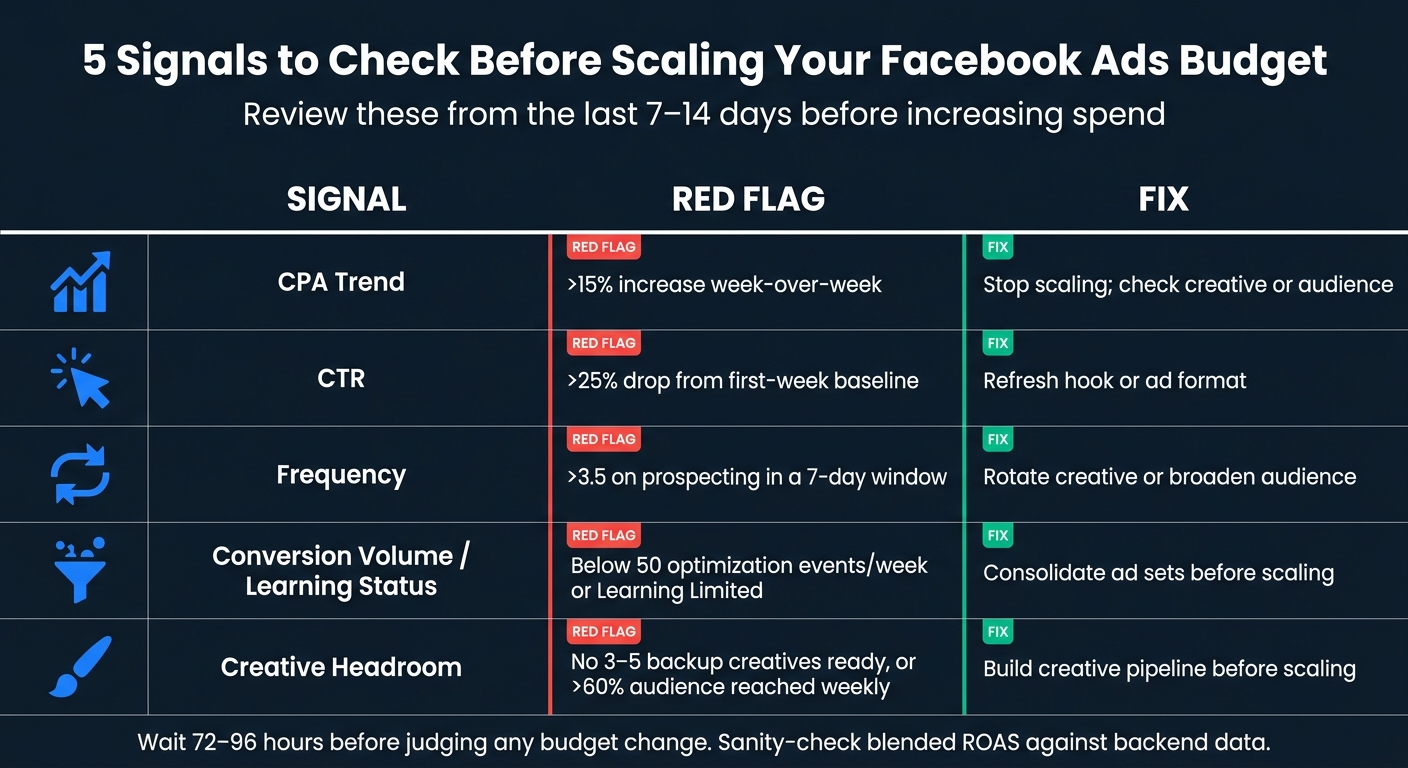
5 Scaling Signals: Red Flags & Fixes for Facebook Ads CPA
5 signals to review before increasing budget
After structure and creative, this is the last check I make before I add more spend.
Scaling works like a loop: check, move, measure.
Before I scale, I review five signals from the last 7 to 14 days.
When CPA starts to drift, I want to know whether the account can handle more budget. I only scale when all five signals look clean.
| Signal | Red Flag | Fix |
|---|---|---|
| CPA Trend | >15% increase week-over-week | Stop scaling; check creative or audience |
| CTR | >25% drop from first-week baseline | Refresh hook or format |
| Frequency | >3.5 on prospecting in a 7-day window | Rotate creative or broaden audience |
| Conversion Volume / Learning Status | Below 50 optimization events/week or still Learning Limited | Consolidate before scaling |
| Creative Headroom | No 3–5 backup creatives ready, or you're hitting more than 60% of the audience weekly | Build the pipeline before scaling |
I also wait 72 to 96 hours before judging any budget change. Then I sanity-check blended ROAS or MER against backend data.
The core takeaway
CPA tends to go up during scale for a few clear reasons: auction costs climb, audiences get tired of the same creative, learning resets happen when budgets jump too fast, and reporting lag can make the account look worse than it is.
These are the five checks I use before I increase spend.
If even one signal is red, I fix that first.