When to Fire Your Marketing Agency (And What to Do in the First 30 Days After)


If purchases are flat, reports look good, and no one can explain the gap, it may be time to fire your agency.
I look at this in a simple way: is the agency failing, or do the numbers behind the business make paid ads hard to win? That’s the whole job. Before you cut ties, I’d check account ownership, tracking, purchase data, margins, and the last 90 days of account changes. After the split, I’d spend the first 30 days locking access, fixing tracking, cutting waste, and rebuilding around purchase data.
Here’s the short version:
- Fire the agency if they focus on clicks, CTR, and impressions while revenue stalls
- Do not blame the agency first if margins, pricing, conversion rate, or checkout are the main problem
- Lock down assets before notice: Meta Business Manager, ad account, Pixel, CAPI, domain, GA4, GTM, billing, and logins
- Export 12–24 months of data before anything changes
- In the first 30 days, pause weak spend, audit tracking, recalculate CAC and margin targets, and relaunch with purchase-first testing
- If all you see in change history is budget edits and bid tweaks, you’re paying for upkeep, not progress
A simple way to think about it: bad agency = weak execution, weak testing, weak control. Broken business = weak offer, weak margins, weak site conversion.
| Issue | What I’d look for | What to do |
|---|---|---|
| Agency problem | No purchase focus, low ad testing, weak reporting, poor account control | Replace or reset the agency |
| Business problem | Thin margins, weak offer, poor site conversion, bad pricing | Fix the business before scaling ads |
| Tracking problem | Meta data does not match Shopify, Stripe, or GA4 | Fix CAPI, Pixel, and event setup first |
If you want a fast answer, start with this question: Are ads failing because the media buying is poor, or because the business cannot support CAC at a profit? That answer should shape what you do next.
Before choosing the replacement, compare the work you need covered. My guide to replacing a paid-social agency with an AI operator includes a responsibility matrix and a fee comparison that separates management savings from total costs.
1. Why firing feels risky, and why staying can cost more
Founders often stick with an agency for one simple reason: firing them feels risky.
They worry about breaking the ad account, losing past data, or getting locked out of assets the agency controls. And that fear is fair. No one wants to pull the plug and make a bad situation worse.
But staying has a price too. You're still paying for ad spend that no longer turns into growth.
What I see in stuck accounts
The pattern is usually pretty clear.
Spend keeps going up. Reports look polished. Impressions are up. CTR looks fine. But when I check Ads Manager against Shopify or Stripe, purchase revenue is flat or sliding.
That gap matters. On paper, things can look okay. In the business, they don't.
A healthy account should show active testing. That might mean tests in creative, account structure, or the offer itself. If the change log is mostly bid tweaks and budget edits, the account isn't being pushed forward. It's being kept alive.
That's where I start to split a weak account from a weak business.
Why founders misread the problem
Founders tend to swing too far in one direction or the other.
Some blame the agency too fast. Others ignore agency issues for far too long.
The real job is figuring out which bottleneck is hurting purchases:
- execution
- tracking
- an offer that can't support paid acquisition at a profit
If the agency keeps blaming "the algorithm" without a written diagnosis and a real test plan, that's the signal.
One bad month is noise. Repeated flat purchase numbers with no clear test plan is the signal.
Next, I separate the agency bottleneck from a broken offer or broken economics.
2. When to Fire Your Marketing Agency, and When the Agency Is Not the Problem
This is where purchase data gives you a straight answer. A lot of founders pull the plug too early. Others wait and burn cash for months. Fire the wrong thing, and you lose both time and money.
Signs the Agency Is the Bottleneck
If the account looks active but purchases stay flat, that's your first red flag.
Start with what the agency is optimizing for. If the account is built around clicks, engagement, or any event that isn't purchases, stop right there. In ecommerce, purchase is the only conversion event that matters.
Then check creative velocity. If new ads aren't going live on a steady basis, the account has gone stale. Right now, creative is the main lever.
Open the change history in Ads Manager. If you mostly see budget edits and bid tweaks, with very little new creative testing or account structure work, you're not getting strategy. You're getting maintenance. And that kind of setup can look pricey for a reason: you're paying high monthly retainers for an account that's not moving.
Ownership matters too. If you don't control Meta Business Manager, Pixel, CAPI, and your domain, then you don't own the account. Fix that NOW.
Pay attention to the calls as well. If the conversation stays stuck on impressions, clicks, and CTR, and no one can walk you through CAC or revenue, that's reporting theater. If every bad month gets blamed on "the algorithm" and there's no written diagnosis or test plan, the agency is ducking the issue.
If those are the failures, the agency is the problem. If not, the next place to look is your offer and your unit economics.
Signs Your Offer or Economics Are the Real Issue
Sometimes the agency isn't the issue at all. The offer, margins, or site can block paid growth no matter who's running the account.
The main question isn't "Is performance bad?" The main question is: Is paid acquisition structurally impossible here? If your gross margins are too thin to support a realistic CAC, media buying won't save you. If traffic reaches the site but checkout is broken, the landing page is weak, or the offer has no product-market fit, firing the agency won't change much.
Compare Meta Ads Manager with Shopify, Stripe, Google Analytics, TripleWhale, or Hyros. If Meta shows traffic but your actual sales data doesn't back it up, find the break.
You may see the same pattern in other places too:
- Weak positioning
- No clear hero product
- Pricing that doesn't fit the market
Paid ads can speed up a working offer. They can't invent one from scratch.
If the business is solid but the account is still drifting, the answer is a reset - not another excuse.
When to Reset the Account
If the agency is honest and responsive, don't fire them yet.
If they're open with the data, willing to share raw numbers, clear about what isn't working, and ready to commit to a written 30- to 60-day scorecard with revenue-tied goals, keep the discussion going.
The reset is pretty simple:
- Simplify the account structure
- Fix CAPI or tracking drift
- Increase real creative testing
If they refuse that reset, fire them.
If you're not sure whether you're dealing with an agency issue or a business issue, that's exactly what my services audit is for. It's $1,000. I review the account with no agenda and tell you what's actually broken. Sometimes the answer is to fire the agency. Sometimes it's to fix the offer first. Either way, you get a neutral diagnosis before you waste another month.
3. What to Lock Down Before You Fire Them
If the agency is the bottleneck, lock down the account before you send notice.
Do it first. The second you give notice, your leverage drops. Some agencies get defensive. Some get sloppy. A few turn hostile. The point isn't just to get through the split. It's to protect the assets that control purchase data and future growth.
Take Back Ownership of the Account and Tracking
Before notice, confirm that your company owns every Meta asset and tracking system.
Check whether you control the account or if you're only listed as a user. Your team should be Admin under People, not just a Partner.
Meta ownership:
- Meta Business Manager
- Ad account(s)
- Meta Pixel and Conversions API (CAPI)
- Verified domain in Meta
- Product catalog
- Facebook Page and Instagram account
Tracking:
- GA4
- GTM
- Server-side tracking
Support assets:
- Domain registrar login
After notice, cut their access down to Advertiser only. Remove access on the contract end date. Change passwords for any shared tools they can still reach.
Once access is locked, gather the files that show how the account was being run.
Get the Asset Handoff: Creatives, Data, and Billing
The asset handoff gives you the clean baseline you need for the 30-day reset. This isn't just a random pile of files.
Ask for everything in one folder:
- Raw creative files, ad copy docs, scripts, and briefs
- Landing page templates they built
- Campaign naming logic, audience lists, and written account structure
- Last 12–24 months of performance history exported from Ads Manager
- Any strategy documentation that currently lives only in their heads
That export gives you a clear baseline for CAC, ROAS, and conversion rates before anything changes.
Move ad spend and all support subscriptions to company-owned payment methods before notice.
Then decide who owns the next 30 days.
Decide Your Operating Model Before You Terminate
The next operator should be the person or team that can relaunch purchase-focused creative and audit the account the fastest.
| Operating Model | What It Means | Trade-off |
|---|---|---|
| In-House Operator | Full-time hire runs the account internally | Full control, higher overhead |
| Lean Internal Team | Small team runs media and creative under your leadership | Fast, but needs strong leadership |
| Fractional CMO + Specialist | Senior strategy plus specialist execution | Flexible, but coordination-heavy |
| Autonomous/Managed Service | Execution runs through a system with less daily management | Less headcount, less visibility |
That choice shapes how fast you can relaunch in the first 30 days.
4. The First 30 Days After Firing Your Agency
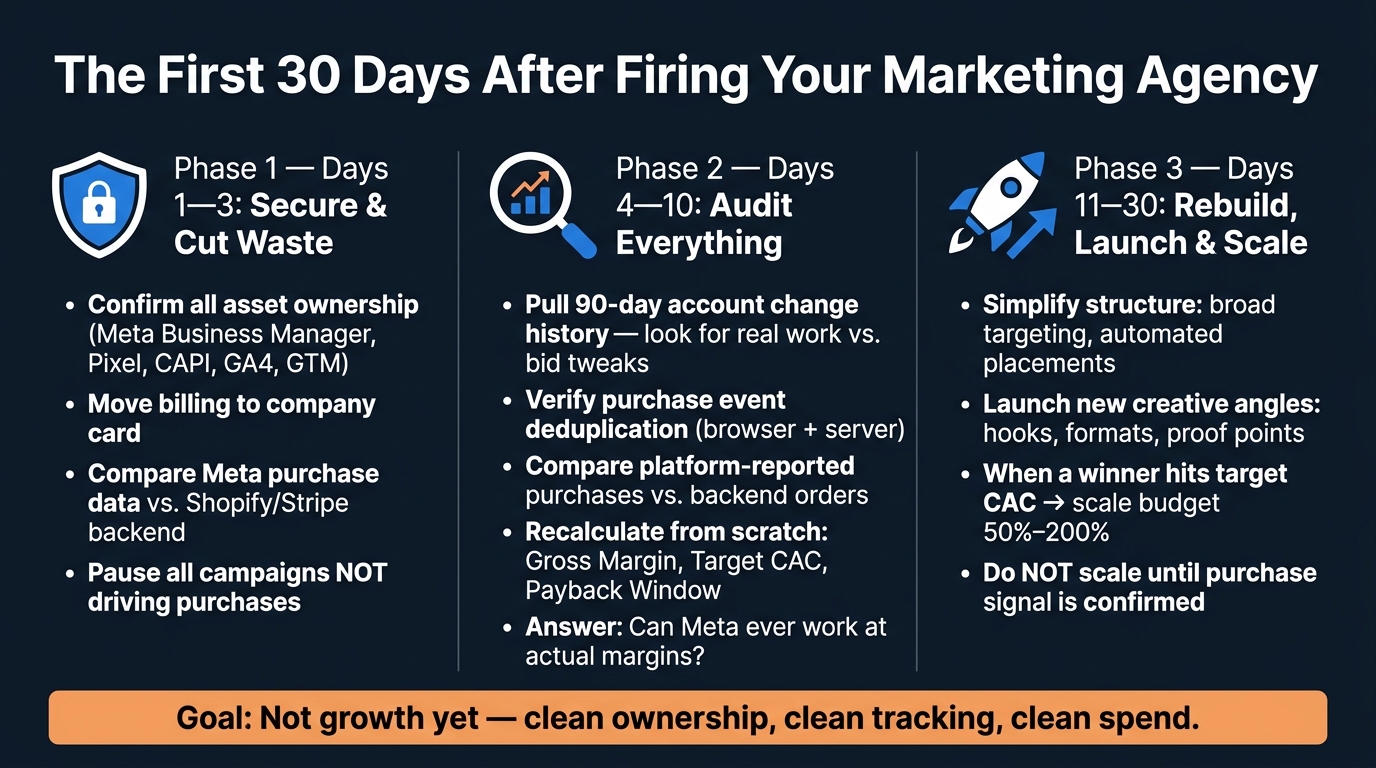
The 30-Day Agency Transition Plan: Secure, Audit & Relaunch
The operating model is set. Access is locked down. Now the countdown starts.
These first 30 days decide whether I drift deeper into a mess or rebuild from a clean base. At this stage, I’m not trying to grow yet. I’m checking ownership, tracking, and spend.
Days 1–3: Secure Access and Cut Obvious Waste
First, I make sure I still control every asset. I confirm billing is tied to my company card, not the agency’s. Then I do one quick data check: I compare Meta’s reported purchase numbers with my Shopify or Stripe backend.
If those numbers don’t match, tracking is broken. That gets fixed before anything else.
On spend, I keep only campaigns that are actively driving purchases. Anything not tied to purchase gets paused. While I’m diagnosing the account, every dollar needs to point to the main conversion event.
Days 4–10: Audit Meta, CAPI, and Unit Economics
Once access and spend are cleaned up, I audit how the account actually works with a Meta ads audit and strategy sprint.
I pull the account change history for the last 90 days. I’m looking for signs of actual work: new creative, account structure changes, and audience tests. If all I find is bid tweaks and budget edits, then the account wasn’t being managed in any serious way. It was just being watched.
Next, I verify the purchase event. I check that browser and server events are deduplicating the right way. A bad CAPI setup can double-count purchases and make ROAS look better than it is. So I compare platform-reported purchases against backend orders and measure the gap.
Then I recalculate unit economics from scratch. I want clear answers:
- What’s my gross margin?
- What CAC can the business support?
- What payback window makes sense?
That’s the point where I answer the question that matters most: could Meta ever work at the business’s actual margins?
If the last agency was optimizing to ROAS instead of margin, they were aiming at the wrong number from day one.
Days 11–30: Rebuild Clean, Launch Creative, and Scale Hard
Once the account clears the audit, I rebuild with new creative and move fast on what works.
I keep the setup simple. Broad targeting. Automated placements. Let Meta do the distribution. The more I overbuild the account, the slower it learns.
From here, creative decides the outcome. I need new angles fast: hooks, formats, and proof points. That’s where ADEN'S LAB comes in. I use it to produce a high volume of creative so the account gets enough signal to find buyers.
When a winner proves itself - meaning it’s driving purchases at my target CAC - I don’t creep the budget up by tiny amounts. A 50% budget increase on a proven winner is still conservative. In the right account, 100% to 200% can make sense.
I ran $1,011,172 through one cost-cap campaign at 3.90 ROAS. the real estate AI SaaS tool went from $15,000/month to $150,000/month in six months with CPA down $8.
That kind of result comes from a clean account, strong creative, and the nerve to push spend once the signal is there.
Conclusion: Get a neutral second opinion before or after the split
I pull the trigger when the failure pattern is plain: no strategy, no transparency, weak ownership, or no purchase-focused execution.
If the last 90 days show nothing but bid tweaks and budget edits, that isn't management.
That said, be honest with yourself. If CTR is solid and conversions are flat, the agency may not be the problem. The offer, landing page, or unit economics may be the issue. Firing them won't fix that.
Once the call is made, the next steps get pretty straightforward. In the first 30 days, secure access, audit tracking and unit economics, then relaunch from a clean account with new creative.
That's the point of the audit: get the diagnosis before you waste another month.
Before or after the split, the cleanest next step is a $1,000 audit. I review tracking, structure, creative, and economics. Book a 30-minute strategy call - direct with me, and leave with a diagnosis.
FAQs
How do I know if it’s the agency or my offer?
Before you point the finger at the agency, check what’s happening on your side first. Tight budget limits, late assets, slow approvals, and clunky internal workflows can all drag down performance. Outside forces matter too, especially competitor moves and algorithm updates.
If none of those explain the drop, look at your offer economics. That’s often where the story gets clear.
And here’s a simple gut check: can the agency tell you what changed this week? If they can’t, or if they keep reporting on numbers that have little to do with your main conversion event, the agency is probably the issue. An independent audit can help verify that.
What should I download before firing my agency?
Before you give notice, do a quiet audit of your digital footprint. Make sure you know what you own, what you can access, and what still lives in shared agency spaces. Then download everything into a private folder you control, not a team drive you could lose access to overnight.
Pull the last 6–12 months of campaign and ad data. Save your baseline numbers too, including ROAS, CPA, and conversion rate. Those figures matter more than most people think. Without them, it gets a lot harder to show past performance or spot where results started to shift.
You’ll also want to lock down access and records for the accounts and assets tied to live work, including:
- Meta Business Manager
- Ad accounts
- Pixels and tracking setup
- Creative source files
- Audience data
- Logins
- Integrations
- Live tests
Treat this like packing up your desk before the office lights go out. If it matters to account ownership, reporting, billing, or campaign history, save it now while access is still clean and simple.
How long should I wait before scaling again?
Don’t wait for some arbitrary timeline. If your ads are strong, scale right away and push hard. I often increase budgets by 50%, 100%, or more.
If you’ve found a winner, bumping spend by 5% to 20% is usually too slow. When results stay flat, the issue is often creative volume and how fast you test - not timing.