Facebook Ads Agency Red Flags: 10 Signs You're Getting Agency'd

Most agencies fail in the same 10 ways: they lock you in, hide the data, control the account, dodge clear answers, move too slow, and talk about clicks while your cost per purchase gets worse.
If you're spending $50,000 to $2,000,000 per month, the main checks are simple: Do you own the account? Can you see live numbers? Are they tied to purchase results? Can they ship new ads every week? Will they push spend when CPA holds? If the answer is no on more than one, you're probably paying for noise.
Here’s the full list at a glance:
- Long contracts with hard exit terms
- Monthly PDF reports instead of live dashboards
- No direct admin access to your Meta ad account
- ROAS screenshots with no spend or date range
- “Proprietary strategy” with no plain-English explanation
- Senior salesperson, then junior handoff
- Slow ad production and weak testing loops
- No clear help with Pixel, CAPI, or tracking checks
- Focus on soft metrics like CTR, reach, and impressions
- Fear of pushing budget when ads are working
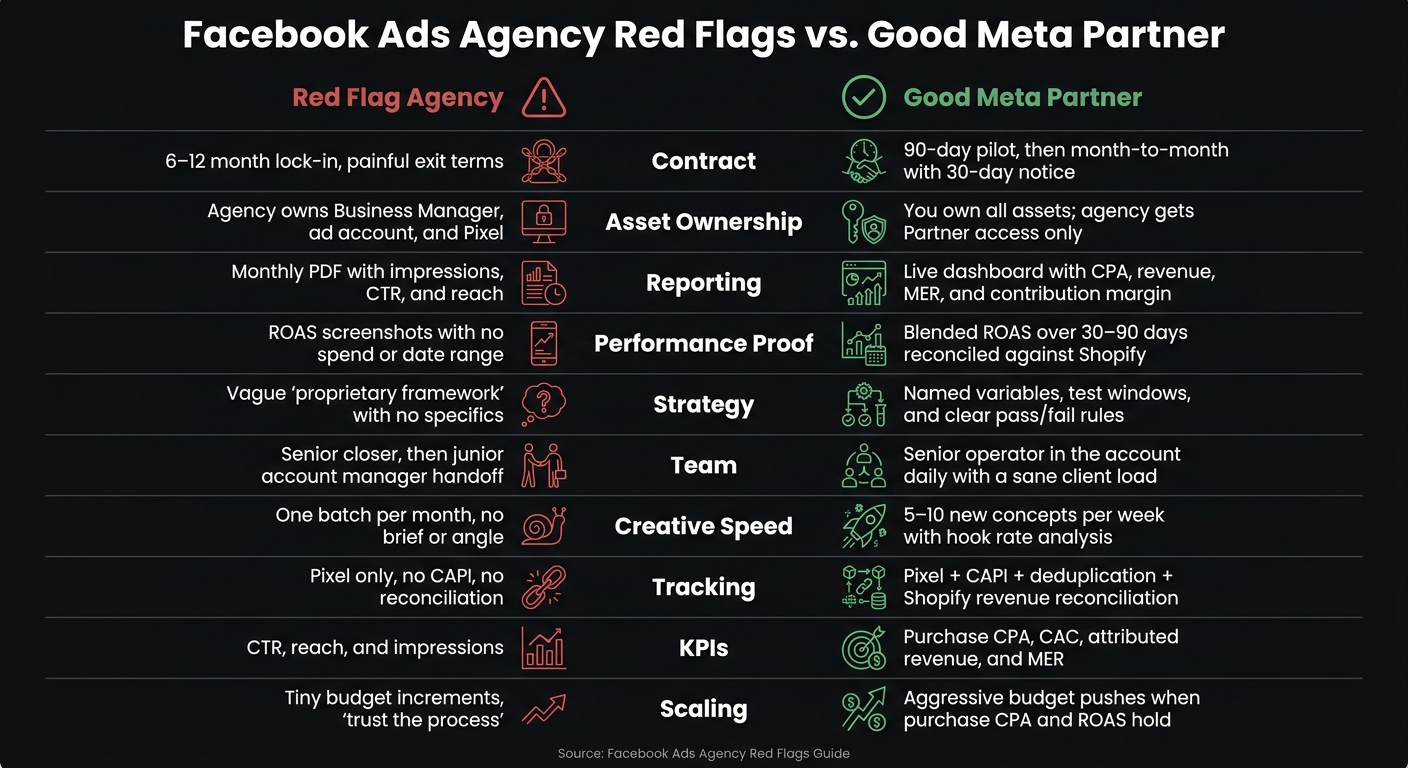
Facebook Ads Agency Red Flags vs. Good Meta Partner: Full Comparison
Quick Comparison
| Area | Red Flag | What I’d want instead |
|---|---|---|
| Contract | 6–12 month lock-in, messy exit | 90-day test, then month-to-month |
| Asset ownership | Agency owns ad account or pixel | You own Business Manager, ad account, pixel, and files |
| Reporting | PDF once a month | Live dashboard with spend, CPA, revenue, and MER |
| Performance view | ROAS screenshot only | Spend, date range, attribution, and Shopify check |
| Plan | Vague “framework” talk | Clear tests, timelines, and pass/fail rules |
| Team | Closer sells, junior runs | Same senior operator in the account |
| Ad pipeline | One batch per month | New concepts every week |
| Tracking | Pixel-only or unclear setup | Pixel + CAPI + deduplication + revenue checks |
| KPIs | CTR, reach, impressions | Purchase CPA, CAC, revenue, MER |
| Scaling | Tiny budget changes | Bigger budget moves when numbers hold |
This article breaks those signs down as one problem: bad incentives. The agency gets paid to keep the account, not to make each dollar work harder.
How to Read These Red Flags
I read each red flag the same way: what it looks like, why agencies do it, and what good looks like instead. I’ve seen enough agency work to know these patterns aren’t random. They’re built into how some agencies operate. That turns each warning sign into a decision point, not a guessing game. That’s the lens I use below.
One red flag can have context. Two or three together usually point to a deeper problem. And that’s where people get stuck. The costly mistake is staying with a mediocre agency because the results are just good enough to make leaving feel painful.
For ecommerce, the main conversion event is Purchase. Not Add to Cart. Not Initiate Checkout. Not Traffic. Not Awareness. If an agency is optimizing or reporting around anything else, they’re tracking motion instead of business impact.
The same standard applies to reporting. ROAS without spend context is noise. I care about revenue, CPA, and MER at the spend level over the same time window. Each red flag below points back to the same incentive problem: agencies tuning campaigns around numbers that make them look good, not around business results. The first place this tends to show up is in contract terms.
1. Long Lock-In Retainers and Painful Exit Terms
A 6- or 12-month term can lock you in before there’s any proof the work is paying off. A solid partner should be open to a 90-day pilot or month-to-month terms.
The ugliest version usually hides in the fine print: early termination fees, vague exit language, or agency control over your Meta Business Manager, ad account, pixel, custom audiences, or creative assets. If you walk away, you’re stuck leaving behind the assets, the data, and any bargaining power.
These long contracts protect agency revenue whether performance stays strong or falls apart. In that setup, the results only need to be good enough to make leaving feel like a headache.
Fair terms look simple:
- You own your Meta Business Manager, ad account, pixel, audiences, and creative assets
- The agency gets Partner access only
- You start with a 90-day max term, then move to month-to-month with 30-day notice
If that isn’t spelled out in writing, don’t sign.
If the contract is built to trap you, the next red flag is the reporting built to distract you.
2. Monthly PDF Reports Instead of Live Dashboards
If the first red flag was control, this one is visibility.
A PDF report lets the agency grade its own homework. They pick the metrics, the date range, and the angle of the story. That setup gives them cover because it pushes accountability down the road.
A monthly PDF also turns 30 days of account drift into one old snapshot. Creative fatigue can show up in days or weeks. By the time the PDF hits your inbox, the ad may already be dead.
PDFs can also hide inactivity. Ads Manager has a Change History log. Every budget tweak, creative swap, and bid change is timestamped. If Change History stays flat for long stretches, the account isn’t being managed closely.
Real visibility looks like this: you can pull Change History yourself and check daily CPA trends, not just a 30-day average that smooths over the drift. A live dashboard should pull from Meta Ads Manager and Shopify in real time.
The metrics that matter are CPA, revenue, and contribution margin. Not impressions. Not reach. Not CTR on its own. If a report leads with impressions, it’s hiding business results.
If you can’t see performance live, the report is theater.
3. No Direct Admin Access to Your Meta Ad Account
This one is structural. If an agency controls the reporting, the next thing to check is who controls the account itself.
If the agency sets up your ad account inside its Business Manager, it owns the pixel, audiences, conversion history, and data. You pay. They keep the keys. And once they control the account, they also control the story around performance. It’s lock-in by design. If you leave, you can lose the asset history that helps the account perform.
That setup also weakens accountability. Without direct admin access, you can’t audit Change History or check the numbers for yourself inside Ads Manager.
The right setup is pretty simple:
- Your company owns the Business Manager and the ad account.
- The agency is added as a Partner with only the asset permissions it needs.
Before you sign, ask one direct question: "If we end the engagement, do we retain full ownership of the ad account, pixel, and all assets?"
There’s only one acceptable answer: yes.
If they hide behind "proprietary methodology" instead of answering, that isn’t strategy. It’s lock-in.
4. ROAS Screenshots Without Spend or Time Context
Screenshots are even less useful than PDFs because they strip away key details. A ROAS screenshot means almost nothing if it doesn't show spend, date range, and attribution window.
Here's how this gets spun: high ROAS on low spend is easy to fake. An agency can pick one nice-looking slice of performance and sell it like it reflects the whole account. That's the play. Make one strong pocket stand in for everything else.
If the date range isn't visible, the screenshot might show a single spike day, a holiday bump, or a short stretch that happened to look good. That's why you should look at blended performance across 30 to 90 days, not a moment-in-time snapshot.
Attribution is another place where the gap gets buried. Some agencies lean on view-through attribution, which gives credit for a sale when someone only saw an ad and didn't click it. Compare that with your actual Shopify orders or server-side revenue, and the mismatch tends to show up fast.
Ask for:
- Total spend
- Blended ROAS over 30 to 90 days
- Clear attribution terms
- Reconciliation against Shopify or server-side revenue
There's one more metric worth separating out. Account-level ROAS can hide revenue from returning buyers. That can make performance look better than it is. New customer ROAS or CAC gives you a much clearer read on what growth is costing.
Once that context disappears, the numbers get a lot easier to sell.
5. "Proprietary Strategy" With Zero Specifics
A lot of agencies love to wave around a "proprietary framework." Sounds fancy. Then you ask what it means, and out comes a pile of buzzwords instead of a clear explanation.
That’s the problem.
If they can’t walk you through the system in plain English, they probably don’t understand it well enough themselves.
The gut check is simple. Ask:
- What are you testing?
- Why are you testing it?
- How will you know it worked?
A real answer gets concrete. It tells you the variable, the test window, and how success gets measured. A weak answer sounds like, "We're constantly optimizing based on our proprietary methodology." That’s not strategy. It’s a stall.
This is one of the main ways weak agencies avoid scrutiny. They keep things fuzzy so no one can pin them down.
Good agencies make the work easy to follow. Bad ones hide behind jargon. You’ll see the same move on the creative side too. If they ask for more content but can’t name the angle, format, or objection they want to address, that’s not strategy either.
| Strategy Component | Red Flag Answer | Real Answer |
|---|---|---|
| Audience | "We'll test different interests and see." | "Start broad, then use creative to see which buyer segment converts." |
| Testing | "We're constantly optimizing." | "Name the variable, the test window, and how success is measured." |
| Creative | "We need more content." | "We need a founder-led video to address the trust objection." |
| Performance | "Trust the process; ROAS is coming." | "We watch the first 3 seconds and the purchase CPA over the same spend window." |
The "proprietary AI" pitch is often the same move with a new label. Ask to see the backend. If they hesitate, that tells you plenty.
When strategy stays this vague, the next red flag usually comes down to who’s actually running the account.
6. Junior Handoff Right After the Sales Call
Once ownership and reporting are clear, the next issue is simple: who's actually in the account each day?
The sales call goes well. A senior strategist wins your trust, closes the deal, and gets the contract signed. Then, right after that, the account lands with a junior account manager who's juggling a stack of other clients.
That's the bait-and-switch. You pay for senior attention, but what you get is junior execution.
The cost shows up in weak decisions. Juniors often fall back on boilerplate account setups and surface-level tweaks. They watch CTR and impressions, but they may miss what matters most: your contribution margin and the business context behind the account. A senior can spot the problem fast. A junior can spend months circling it.
That's why access matters more than promises. The handoff tells you almost everything. Don't just ask who sold you the work. Ask who is actually inside Ads Manager.
Before you sign anything, ask who logs into Ads Manager every day. Then check it. Pull the Change History inside Meta Ads Manager. It shows who made each edit and when. If the log is quiet, or the name making changes is someone you don't know, that's a red flag. A senior shouldn't be stretched across a long list of brands.
7. Slow, Fragile Creative Production
Once I know who’s inside the account, I ask one thing: how fast do they ship new creative? If the team is junior and the pipeline moves slowly, the account gets stuck in two ways.
Most agencies work on a fixed release schedule: one batch a month, sometimes every two weeks. That’s too slow. When an ad stops working, you need replacements now. High-production videos often cost more, but they don’t help you test faster. In practice, speed beats polish.
The feedback loop is often broken too. When a batch underperforms, a healthy team asks what hook failed and why. A fragile team just asks for “more content.” No angle. No brief. No purchase data. That’s a content request, not a plan. And it shows the same agency habit: pushing volume instead of purchase results.
Good looks like this:
- A clear brief tied to purchase data
- Fast iteration on winning hooks
- Enough volume to keep testing without stalling the account
If they can’t connect creative tests to purchase data, the next problem is tracking.
I’ve used ADEN'S LAB to generate tens of thousands of creative variations. At scale, creative becomes the targeting layer. Meta scales what the market responds to. If you’re only refreshing creatives once a month, you’re not giving the algorithm enough signal to keep finding winners.
8. No Help With Tracking, Pixels, or CAPI
If an agency doesn't bring up tracking in the first meeting, that's a red flag. This is usually where weak work starts to show.
Why? Because clean tracking makes it much harder to hide poor account management. When the setup is messy, the agency can blur the numbers and make weak results look better than they are.
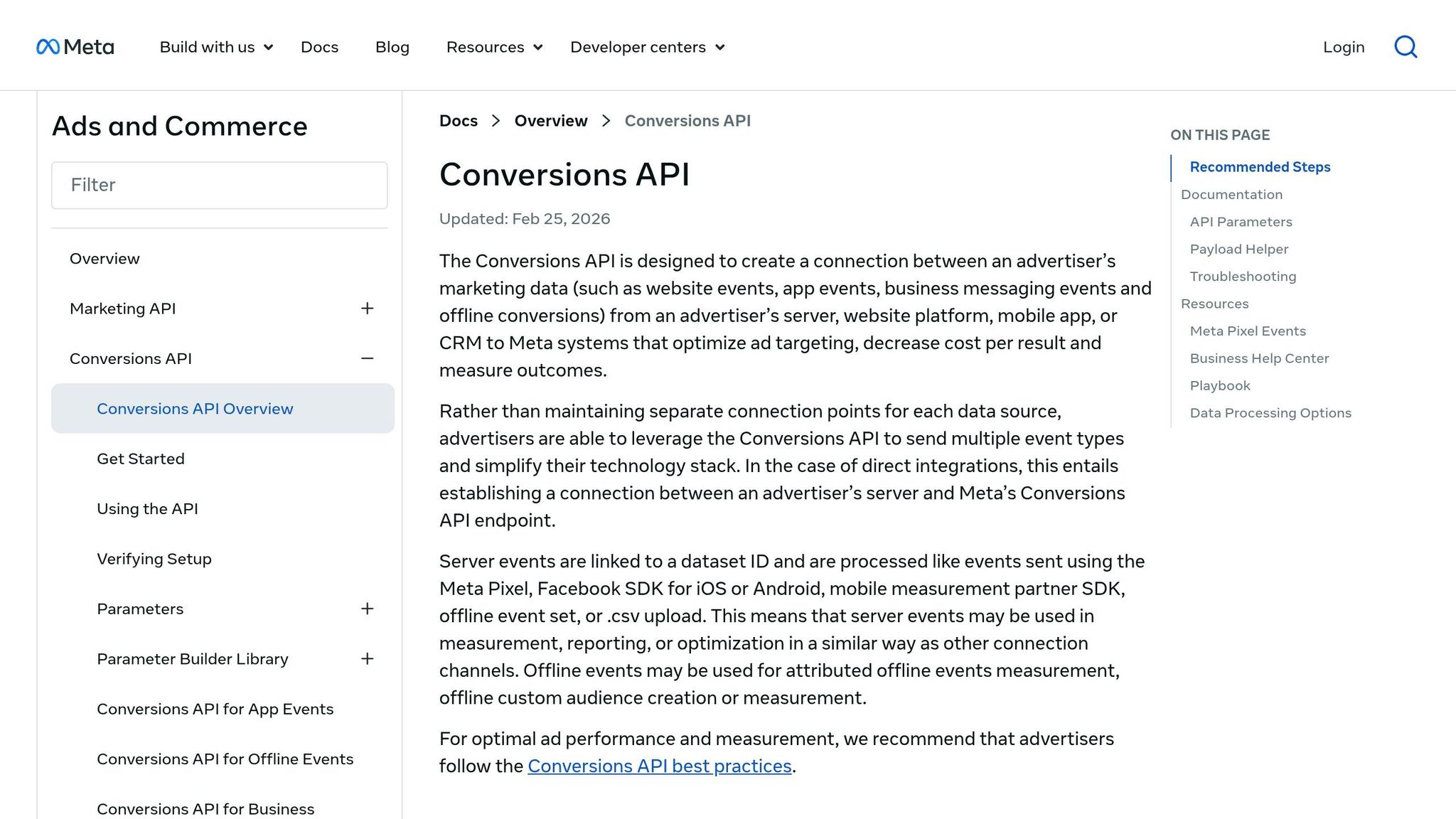
A Pixel by itself isn't enough. Without CAPI, Meta learns from incomplete data and makes weaker optimization decisions. And when the signal is off, reporting starts to drift too.
Ownership matters just as much. If the agency builds the Pixel inside its own Business Manager, you don't own your tracking setup. You're basically renting access to your own data. The moment you leave, you can lose historical data, audiences, and optimization signals.
The brand should own:
- the Pixel
- the GTM container
- the Business Manager
The agency should only have partner access. If you don't control the stack, you can't check the numbers with confidence.
A proper tracking stack isn't hard to explain: Pixel, CAPI, deduplication, and hashed customer data for advanced matching. After that, I reconcile Meta against Shopify. If Meta reports far more purchases than Shopify, something is broken.
I set up CAPI on every account I manage. It's not optional. If purchase data is wrong, everything else is just noise.
9. Strategy Built Around Soft Metrics and "Trust the Process"
Once tracking is clean, weak agencies often lean on softer numbers.
This red flag shows up when attention shifts to metrics that look nice on a report but don’t move revenue. When results start slipping, some agencies pivot to numbers that protect the retainer instead of the business. Impressions are up. CTR looks fine. Reach is growing. Nice to hear. But none of that pays the bill.
If an agency leads with impressions, CTR, or reach, that usually means the business numbers look worse. Pull Change History in Meta Ads Manager. If nothing meaningful has changed in the last seven days, they’re not running much of a strategy. They’re collecting a retainer and calling it strategy.
"Trust the process" is the stall. Yes, ads can take time. But a real process has specifics. It should spell out:
- How many creatives are being tested
- What CPA threshold kills an ad
- What milestone comes next
Vague timelines with no milestones aren’t a process. They’re retainer protection.
Ask for purchase CPA, attributed revenue, and blended ROAS. If it’s ecommerce, purchase is the only conversion that matters.
Soft metrics buy time, not growth.
If they resist actual scale after hiding behind soft metrics, the next tell is how they react when you raise budget.
10. Fear of Aggressive Budget Increases When Ads Are Working
A winning ad doesn't last forever. When CPA is where it should be and purchase ROAS is still holding, you need to scale fast before fatigue kicks in.
This is where weaker agencies flinch. I've moved budgets up by 50% to 200% in a single push when the numbers backed it up, including $544,397 in 72 hours during BFCM 2025. You can see the breakdown at /work/blackfriday. Move too slowly, and you're leaving revenue on the table.
Why agencies stay conservative: with a flat retainer, aggressive scaling means more work, more pressure, and more client communication without more pay. So they drag their feet. If tracking is shaky, they're even less likely to push spend because problems show up fast. And if they won't scale spend, they usually won't scale creative either.
What good looks like: when a campaign hits target CPA, push the winner hard and get new hooks, formats, and angles live right away. At that point, creative volume becomes the bottleneck. A simple test is to ask what they do when a campaign starts hitting goal CPA. If their answer is to inch budgets up over several weeks, they're too slow.
That hesitation isn't random. It's baked into the agency model. This isn't a skill issue. It's an incentive issue.
Why These Problems Keep Happening Inside Agencies
These red flags usually come back to one thing: the agency gets paid on a different clock than the client gets results. Once that happens, the same pattern tends to show up in the contract, the team setup, and the reporting.
It often starts with long retainers. Those deals protect agency revenue before the work has proved it can drive results. Same incentive, different symptom.
You see it again in staffing. Thin teams and split roles often lead to the same outcome: the closer makes the sale, a junior person runs the account, and no one owns the work from end to end. Same incentive, different symptom.
Reporting follows the same pattern. Templated PDF reports make it easy to lead with vanity metrics like impressions, CTR, and reach. On paper, those numbers can look fine. Meanwhile, revenue stays flat. Same incentive, different symptom.
That structure is what good looks like.
What a Good Meta Ads Partner Looks Like
The fix is simple: line up control, reporting, speed, tracking, and scale with my business. Good Meta work stays simple because the incentives are simple too. The core pieces are ownership, visibility, speed, tracking, and scale.
I own the Business Manager, ad account, pixel, and creative assets. A good partner should only need Partner access. That keeps control where it belongs and avoids the mess that happens when an agency builds everything under its own setup.
Reporting is live. I should be able to open Ads Manager at any time and see performance in real time, what changed, and which tests are running. The numbers that matter are CPA, revenue, contribution margin, and MER - not vanity metrics like impressions or CTR.
Creative moves fast. No backlog. No monthly content batches. If an account is spending hard, it needs new creative every week to fight fatigue. The goal is fast iteration on winning hooks, not slow production cycles that drag on forever.
Tracking is non-negotiable. I want Conversions API, deduped pixel events, and reconciliation against Shopify or CRM data. If the numbers don’t match up, I’m not scaling it. Simple as that.
Scaling is aggressive. When purchase CPA and revenue hold, a good partner pushes hard and expands creative fast.
That’s the baseline. Next, I’ll put the red-flag version and the good version side by side.
Red-Flag Agency vs. Good Meta Partner: Side-by-Side
Here’s the fast audit. This is the shortest way I know to spot a bad setup fast.
| Red-Flag Agency | Good Meta Partner | |
|---|---|---|
| Access & Ownership | The agency owns the Business Manager, ad account, and Pixel. If you leave, you lose everything. | You own all assets. The partner only gets access - nothing else. |
| Reporting | You get a monthly PDF with impressions, CTR, and reach. Nice-looking metrics that can hide profit. | You get a live dashboard with revenue, MER, CAC, and contribution margin in real time. |
| Creative Speed | One batch a month, if that. Then they come back asking you for more assets. | New concepts every week, plus hook rate analysis. |
| Staffing | A senior strategist closes the deal. Then a junior team member with a packed roster handles your account. | A senior operator runs the account, with a sane account load. |
| Tracking Setup | “The pixel is fine.” But there’s no CAPI, no reconciliation, and no clear read on whether the numbers are right. | CAPI is in place. The Pixel is deduped. Revenue is reconciled against Shopify or CRM data. |
| Optimization Event | Anything other than the main conversion event. | The main conversion event only. |
| Scaling Approach | Tiny budget bumps. “Trust the process.” | If the numbers hold, they scale hard. |
Proof From My Accounts
These results came from direct account control, fast-moving creative, clean tracking, and hard scaling. That’s what it looks like when the pieces are set up right and the execution is sharp.
$814,769 in a single month at 4.51 ROAS. Clean CAPI and revenue-based reporting.
$1,011,172 through one cost-caps campaign at 3.90 ROAS. Tight cost-cap control.
$239,000 in spend → $1.98 million in revenue at 8.27 ROAS. Creative volume drove this.
$544,397 in 72 hours during BFCM 2025. I scaled hard because the efficiency held. Full breakdown at /work/blackfriday.
$43,193 in a single day. Real-time account control.
That’s the difference between having decent numbers on a dashboard and knowing how to push an account when it counts. Next: what that execution looks like day to day.
What Good Execution Looks Like in Practice
Here’s what an account looks like after the red flags are cleaned up.
the real estate AI SaaS tool is a good example. Monthly spend climbed from $15,000 to $150,000 in six months, while CPA fell by $8. That’s 10x growth with a lower CPA. The account kept a high flow of new ads, tracking was clean enough to trust, and I pushed budget hard when the numbers kept holding. Full breakdown at /work/real-estate-ai-saas-tool.
BFCM 2025 shows the same thing in a high-pressure window. I scaled hard because the numbers held: $544,397 in 72 hours. That only happens when new concepts are already lined up and ready to go. Full breakdown at /work/blackfriday.
Creative is where a lot of accounts crack. In active accounts, I run 5–10 new concepts per week. This isn’t random testing. It’s a set system across hooks, angles, and formats. ADEN'S LAB is the system I built to keep that running at scale. It cuts the production bottleneck, so the account doesn’t sit there waiting for new assets. More on that at /work/adenslab.
Once the signal is clean, reporting turns into a decision tool instead of decoration. CAPI runs server-side next to the Pixel. I look at revenue, ROAS, and MER first. If the signal gets noisy, every decision after that gets worse.
Conclusion
You don’t need agency theater. You need someone who can open Ads Manager, show the numbers, and explain the move.
These aren’t random slip-ups. They’re incentive problems. That’s the thread running through all ten red flags.
I want ownership, live reporting, fast creative, clean tracking, and aggressive scaling when the numbers hold. If you need the full-stack version of this, see /services.
The FAQ below covers the common edge cases and objections.
FAQ
What are the biggest Facebook ads agency red flags before signing a contract?
The biggest red flags are simple: a lock-in contract with no way out if results miss the mark, no admin access to your ad account, and fuzzy talk about a "proprietary strategy." That kind of wording often means you won't get a clear view of what they're doing. And if an agency talks about reach and impressions before purchase CPA and ROAS, they're showing you where their focus is.
How can I tell if an agency is hiding poor performance?
Watch what they lead with. If the report is heavy on impressions, CTR, or awareness, and light on the numbers tied to sales, that's a warning sign. You can also check Change History in Meta Ads Manager. If the log barely moves for weeks while they say they're "actively optimizing", they're covering up inactivity.
Should I own my Meta ad account, or can the agency hold it?
You should own the Business Manager, ad account, Pixel, and CAPI setup. The agency should have Partner access only. That's the clean setup, and it keeps control where it belongs.
Is ROAS a reliable metric to evaluate an agency's work?
ROAS can help, but only if you see it in context. Spend, date range, and attribution settings all shape that number. Before you trust any ROAS figure an agency shares, line it up with Shopify or your backend revenue. If those numbers don't match, something's off.
When should I fire a Meta ads agency?
If primary KPIs stay below the agreed floor for 2–3 straight months, it's time to act. Same goes if they make account transfer hard or refuse to hand it over. When targets are missed and access becomes a fight, the setup itself is broken. Get admin rights, raw creative files, and campaign data before you remove their access.
How fast should a good agency produce new creative?
For high-spend accounts, a good pace is 5–10 new creative concepts per week. A monthly cycle just doesn't move fast enough.