Hiring a Facebook Ads Expert: 12 Questions That Expose Pretenders

Hiring the wrong Facebook Ads expert can waste your budget, ruin your campaign data, and delay results. With Meta's Advantage+ automating much of targeting, today's experts must excel at creative strategy and data analysis - not just media buying. To separate true professionals from amateurs, ask these 12 questions during the hiring process.
For a practical follow-through after the interview, give the candidate this bounded account and creative work sample. It tests the decisions behind the answers.
Key Questions to Ask:
- Who manages my account daily? Ensure it’s not handed off to juniors.
- How do you diagnose underperformance? Look for specific metrics like CPM, engagement, or conversion rates.
- How do you segment audiences? Broad targeting with exclusions is the norm now.
- What’s your creative testing process? Structured frameworks matter.
- How do you handle budgets and bids? Tailored strategies over default recommendations.
- How do you address unreliable tracking? Cross-check Meta data with GA4 or CRM tools.
- What metrics do you prioritize? MER and blended CAC over just ROAS.
- How do you scale campaigns? Controlled budget increases and testing new angles.
- What’s your approach to troubleshooting? Systematic steps, not random tweaks.
Quick Tip:
Request a trial project or standalone audit before committing to a long-term retainer. This will reveal their approach and skills without risking your full budget.
Hiring the right expert means finding someone who owns the process, uses data effectively, and prioritizes your business goals. Use these questions to ensure you’re making a smart investment.
Real Operator vs. Pretender: What Actually Separates Them
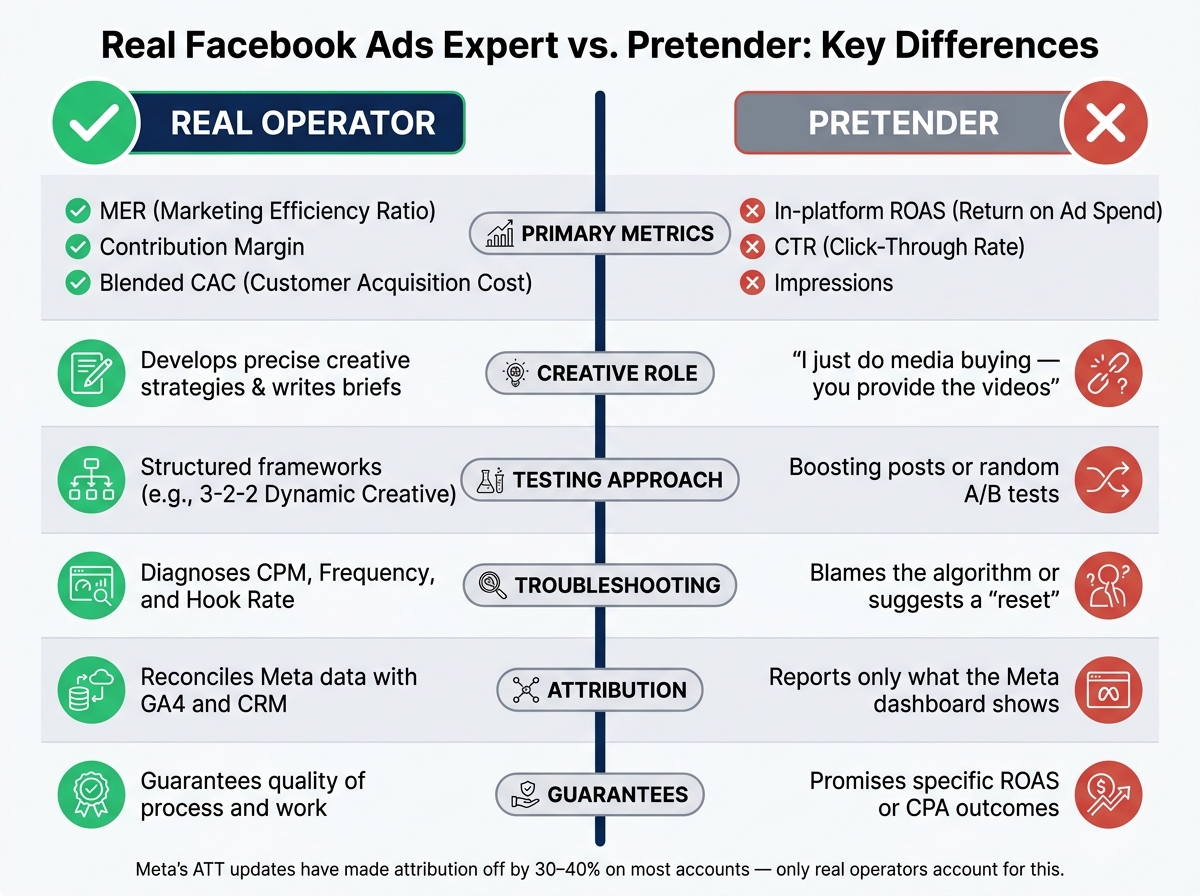
Real Facebook Ads Expert vs. Pretender: Key Differences
It’s not always easy to spot the difference between a real Meta ads operator and someone who just talks the talk. On a sales call, both might sound convincing, rattling off metrics and buzzwords. But when campaigns hit a snag, their true expertise - or lack thereof - becomes crystal clear. Let’s break down how their approaches diverge when problems arise.
The first major distinction is creative ownership. A real Meta ads operator understands that creative is the backbone of targeting. With Meta's Advantage+ system largely automating audience selection, the operator focuses on crafting highly targeted creative strategies to make the most of it.
The second key difference is accountability. When a campaign falls short, a real operator dives into the data. They’ll analyze CPM trends, frequency, and hook rates to pinpoint exactly where the funnel breaks down. On the other hand, a pretender blames the algorithm - or worse, claims the algorithm needs a "reset." That kind of excuse doesn’t just fail to solve problems; it undermines trust.
Here’s a quick comparison of how real operators stack up against pretenders in critical areas:
| Area | Real Operator | Pretender |
|---|---|---|
| Primary metrics | MER, Contribution Margin, blended CAC | In-platform ROAS, CTR, impressions |
| Creative role | Develops precise creative strategies | Offers minimal creative contribution |
| Testing approach | Structured frameworks (e.g., 3-2-2 Dynamic Creative) | Boosting posts or random A/B tests |
| Troubleshooting | Diagnoses CPM, Frequency, and Hook Rate | Shifts blame to the algorithm |
| Attribution | Reconciles platform data with GA4 and CRM | Reports only what the Meta dashboard shows |
| Commitments | Guarantees a specific process and quality of work | Promises a specific ROAS |
Another red flag to watch for is the bait-and-switch. This happens when a senior strategist wins your business but then hands off your account to a junior with only six months of experience. That’s a recipe for neglect. To ensure quality attention, each strategist should manage no more than 8–10 accounts. If a company dodges questions about who’s actually managing your account day-to-day, that’s all the answer you need.
12 Questions to Ask Before You Hire a Facebook Ads Expert
These questions are designed to uncover how a candidate truly operates within an account - not just how well they can deliver a polished sales pitch. Ask them directly, without giving prior notice.
Each question builds on the previous one. A weak answer early on often signals more underwhelming responses later. Below, you’ll find the questions paired with examples of ideal and concerning answers to help you evaluate candidates effectively.
1. Who actually manages my account day-to-day?
This is a critical question that candidates sometimes dodge.
Ideal answer: "I do. I'm the one inside Ads Manager reviewing performance, making creative decisions, and adjusting bids. Here's how many accounts I'm currently managing." A strong candidate will name themselves, provide a specific number of accounts, and describe their daily tasks in detail.
Red flag answer: "Our team handles day-to-day management." Vague mentions of "the team" often mean that a junior buyer, someone you’ve never met, will actually run your account. At retainer levels of around $1,500/month, this is common.
Before signing a contract, insist on meeting the person who will actively manage your Ads Manager. Also, ask about their workload. If they’re managing more than 8–10 accounts, it’s a sign that their attention and quality might be stretched thin.
2. How do you diagnose a campaign that stops performing?
This question highlights whether the candidate relies on data or just intuition.
Ideal answer: "I start by identifying where the issue lies - examining metrics like CPM, creative engagement, and conversion rates. For example, a spike in CPM could indicate auction issues, while a drop in engagement might point to creative problems. If frequency is unusually high, it could mean audience fatigue. I then run focused tests to isolate and solve the problem."
Red flag answer: "I adjust the campaign and test various audiences." This vague response suggests a lack of precise diagnostic steps.
The key difference is that a clear diagnosis leads to actionable solutions, while a generic approach risks wasting your budget without fixing the root issue.
3. Walk me through how you build and segment audiences.
With Meta’s Advantage+ system automating much of the audience selection, candidates relying on manual interest stacks may already be falling behind.
Ideal answer: "For most accounts, I use broad targeting and let Advantage+ handle distribution. I also carefully create exclusion lists - removing existing customers, recent buyers, and those who’ve already converted - to prevent wasted spend. For retargeting, I segment audiences by engagement depth and time windows to maintain precision."
Red flag answer: "I target people interested in [your product category] and similar brands." This approach is more of a default setting than an actual strategy.
4. What does your creative testing process look like?
Given that creative is the most important factor in Meta advertising, a structured testing process is essential.
Ideal answer: "I run structured tests by isolating one variable at a time, such as the hook, format, or angle. I follow a repeatable framework to identify winning elements, which then move into scaling campaigns. I also track the success rate of ads to refine the creative process over time." For brands spending $50,000–$100,000/month, this often means producing 20–40 new ad concepts monthly to combat fatigue.
Red flag answer: "I test a few versions and see what performs." Without a clear testing framework, there’s no way to consistently improve creative over time.
5. How do you decide on bidding strategy and budget allocation?
This question evaluates whether the candidate understands the reasoning behind specific bidding strategies - not just which buttons to click.
Ideal answer: "It depends on the account’s learning phase and margin structure. For new accounts or offers, I usually start with lowest-cost bidding to gather initial data. Once I establish a reliable cost-per-acquisition baseline, I switch to cost cap to maintain efficiency while scaling. If I’m aggressively pushing volume, I might use manual bids to set a hard ceiling on what I’m willing to pay per result."
Red flag answer: "I rely solely on Meta’s recommendations." Blindly following platform suggestions shows a lack of tailored strategy.
6. How do you handle tracking and attribution when platform data is unreliable?
Since Apple’s ATT updates, Meta’s attribution data is often off by 30–40% on most accounts. A strong candidate will have a clear strategy for navigating this.
Ideal answer: "I compare Meta Ads Manager data with GA4 and backend CRM or Shopify revenue figures. For instance, if Meta reports 100 conversions but the CRM shows only 60, I investigate the CAPI setup, pixel firing, and advanced matching to identify discrepancies. I also track MER at the business level to avoid relying solely on platform attribution."
Red flag answer: "I just go by what Meta reports."
"Attribution is where most agencies reveal whether they're sophisticated or just reading platform dashboards." - Newbird
Ask about the tools they use, such as TripleWhale or Hyros, and ensure they can explain why those tools are effective.
7. What metrics do you track beyond ROAS?
In-platform ROAS only scratches the surface. Candidates who don’t look beyond it may not understand the bigger financial picture.
Ideal answer: "ROAS shows what Meta estimates, but MER - total revenue divided by ad spend - reflects the actual performance. I also track blended CAC, contribution margin per order, and LTV by cohort to ensure scaling is profitable."
Red flag answer: "I focus on ROAS and CTR." While these metrics are helpful, they don’t provide a full view of profitability.
For example, a geo holdout test revealed a platform-reported ROAS of 4.1x versus an actual incremental ROAS of 2.4x. Such discrepancies can mean the difference between profit and loss.
8. How do you scale a campaign that's working?
Scaling isn’t just about raising the budget. This question checks if the candidate has a thoughtful scaling strategy.
Ideal answer: "I start by scaling horizontally - testing new hooks, formats, and angles - to reach new audiences. When increasing budgets, I do so in controlled increments (around 20% every 3–4 days) while monitoring MER and blended CAC to catch efficiency drops early."
Red flag answer: "I just increase the budget when results look good." This response suggests a lack of structure in their scaling approach.
Given privacy changes, Meta’s platform-reported ROAS often underestimates true performance by 20–40%. Using blended metrics is crucial during scaling.
9. What do you do when a campaign underperforms?
Here, you’re looking for a systematic approach rather than impulsive adjustments.
Ideal answer: "I follow a checklist: first, I check for creative fatigue; next, I look for audience overlap; then I assess whether the offer aligns with the audience; and finally, I review landing page conversion rates. I avoid making changes until I pinpoint the exact issue. For example, if it’s creative fatigue, I refresh top-performing ads with new hooks."
Red flag answer: "I just make a quick tweak here and there and hope the numbers improve." This approach lacks structure and risks wasting ad spend.
How to Score the Answers and Make a Hiring Decision
Each answer a candidate gives should help you gauge how well they fit a hands-on, accountable approach. After going through these 12 questions, you’ll have a clear sense of their expertise and approach.
A true operator’s responses are interconnected. Their approach to diagnostics smoothly integrates testing and scaling. If one answer is strong but the next feels vague, that inconsistency is a warning sign. For instance, if they can’t clearly explain their testing cadence, it’s likely they’re improvising with your budget - something you can’t afford.
Certain behaviors should immediately disqualify a candidate. For example, anyone who guarantees specific ROAS or CPA outcomes is not being honest - no one can promise profits in an unpredictable market. Similarly, candidates who get defensive when discussing attribution discrepancies or who fail to articulate their testing cadence clearly are not the right fit.
Before making a final decision, consider testing their skills through a small project. You can ask for a standalone audit (typically $250–$500) or a creative brief (around $150–$300). This gives you a glimpse into their ability to research, strategize, and communicate - all without committing to a long-term retainer. And once you do hire someone, always grant them Advertiser access in Meta Business Manager, not Admin, to safeguard your account.
Here’s a quick comparison of traits that set apart a hands-on expert from a potential liability:
| Signal | Real Operator | Pretender |
|---|---|---|
| Troubleshooting | Analyzes CPM, Frequency, and CTR to identify problems | Suggests "changing the audience" or "boosting" as a blanket solution |
| Creative Role | Writes briefs, drives testing, and takes ownership of creative strategy | Says, "I just handle media buying - you provide the videos." |
| Primary Metric | Focuses on MER, Contribution Margin, and blended CAC | Relies heavily on platform ROAS or CTR |
| Guarantees | Guarantees quality of work and process | Promises specific ROAS or CPA outcomes |
| Reporting | Links ad performance directly to business revenue | Offers only a monthly spreadsheet of platform metrics |
If the candidate’s answers consistently align with the left column, you’ve likely found someone who’s a good fit. On the other hand, if responses from the right column pop up more than once, it’s time to move on. This framework provides a clear way to evaluate candidates and helps set the stage for making the right hiring decision, as outlined in the conclusion.
Conclusion: Ask These 12 Questions Before You Sign Anything
These 12 questions are more than just a checklist - they’re your tool for identifying real expertise. Each one is crafted to uncover whether the person you’re speaking with has a genuine, actionable process or is just delivering a polished sales pitch. Falling for surface-level confidence could cost you valuable ad spend.
The truth is, there’s no barrier to calling yourself a Facebook Ads expert. Anyone with a laptop can make the claim. But the difference between a true professional and a pretender lies in their ability to explain their thought process in real time. For example, imagine asking during a live call, “CPA doubled in three days, what’s your first move?” A real expert will walk you through their strategy without hesitation, while someone unqualified might falter or offer vague answers.
Pay attention to how their responses connect. A skilled operator’s logic will flow naturally - from diagnosing the problem, to forming a creative strategy, to outlining clear measurement tactics. If someone speaks confidently about scaling but stumbles when discussing attribution issues, that’s a warning sign.
Before locking into a long-term agreement, request a paid test project. This could be something like a standalone audit or a creative brief, giving you a chance to assess their approach firsthand. Instead of jumping into a lengthy retainer, start with a trial period of 30 to 90 days.
Take these 12 questions into your next call and listen carefully for answers that demonstrate a solid process. If you’d like to go through these questions with someone qualified to address them, book a call and take the first step.
FAQs
What should I pay a Facebook ads expert in the U.S.?
Freelance Facebook ads experts in the U.S. generally charge between $1,000 and $2,000 per month for junior-level work. For more experienced professionals, like senior strategists, rates typically range from $3,000 to $5,000 per month.
If you opt for an agency, costs can vary widely. They usually start around $1,500 per month but can exceed $10,000 per month, depending on the scope of services and the agency's expertise.
How can I verify who’s actually managing my Ads Manager?
To ensure clarity about who’s managing your Ads Manager, always grant Advertiser access rather than admin access. This maintains control over your account while allowing them to do their job. To verify their work, ask for tangible proof like a recorded audit, screenshots of the dashboard, or even a live walkthrough of your account. A genuine professional will provide detailed insights, share performance results, and explain their strategies clearly. Be cautious of relying solely on slide decks - they often lack the transparency you need.
What should a paid audit or trial project include?
When considering a paid audit or trial project for a Facebook Ads expert, aim for a small, self-contained task to gauge their abilities before making a long-term commitment. For instance, you could opt for a $250–$500 audit, giving them "View Only" access to your ad account. They can then provide a recorded 10-minute video analysis of their findings. Alternatively, you might test their creative skills by having them draft three video scripts and accompanying headlines. This approach helps you evaluate their research, strategic thinking, and copywriting expertise.