AI Ad Creative at Scale: How I Test 100 Facebook Ad Variations a Week

Most Meta ad accounts don’t stall because of targeting. They stall because they don’t ship enough new ads. My system fixes that with one rule: test a lot, judge only on purchases, and replace tired winners every week.
Here’s the whole idea in plain English:
- I start with the offer, not the ad
- I turn one offer into angles, hooks, copy, and format variations
- I launch about 100 ad versions per week
- I use ABO so each test gets spend
- I keep 20% to 30% of budget for testing
- I cut ads fast based on hook rate, CPA, learning, and frequency
- I move winners into scaling, then remake them for Feed, Reels, retargeting, and sale periods
A few numbers drive the whole system:
- Marketers pick winning ads only about 15% to 20% of the time
- Winning ads can wear out in 5 to 8 days
- Meta ads management services can help when manual ad production takes 2 to 8 hours per ad
- If hook rate is under 25% after 1,000 impressions, I cut it
- If CPA is above 2x target after 5 days, I archive it
- When frequency goes past 2.5 over 7 days, performance often starts to slip
The point is simple: volume beats guesswork. I don’t try to predict winners by taste. I build many versions from buyer language, launch them in batches, and let purchase data decide what stays.
That’s the system behind the article: a weekly loop built for output, fast cuts, and hard scaling when the numbers line up.
Why AI Ad Creative Is the Scaling Moat in 2026
Meta Finds the Audience - the Ad Does the Selling
With broad targeting, the hook, message, and first frame become the signal Meta learns from. In plain English: Meta reads the creative and uses it to find people who look like likely buyers, without all the manual audience setup.
So the creative doesn't just sell the product. It also tells Meta who should see the ad.
Once the algorithm starts learning from the creative itself, a new bottleneck shows up: volume.
Why Most In-House Teams Cap Out at 5 to 10 New Ads a Month
Most teams hit the same wall. A single manual ad usually takes 2–8 hours to make when you count briefing, design, and revisions. That helps explain why many in-house teams top out at just 5 to 10 new ads per month. That's the gap my system is built to close.
And there’s another issue: picking winners. Even pro marketers only predict the winning creative 15–20% of the time. So now you have two problems working against each other:
- Production is slow
- Human judgment is often off
That combination turns creative into the same old choke point.
| Monthly Ad Spend | Weekly Fresh Creatives Needed | Active Creatives at Once |
|---|---|---|
| $5,000 – $15,000 | 12 – 20 | 15 – 25 |
| $20,000 – $50,000 | 25 – 50 | 30 – 60 |
| $100,000+ | 75 – 150 | 80 – 200 |
(Source: Adligator)
How ADEN'S LAB Cuts Production Time
That’s why I built ADEN'S LAB. It’s an end-to-end pipeline that turns offer inputs into ready-to-run Meta ads. I’ve generated tens of thousands of creatives through it.
One brand using it is MR. POWERZ - a 6-figure brand run on 100% AI-produced assets, from statics to video variants to every hook test. The speed change here isn’t small. It puts the whole operation in a different lane.
If a winner starts to fatigue, the next batch can’t still be sitting in review. It has to be ready to go. That’s why my pipeline starts with the offer, not the ad.
My AI Creative Pipeline: From Offer to Ad Set
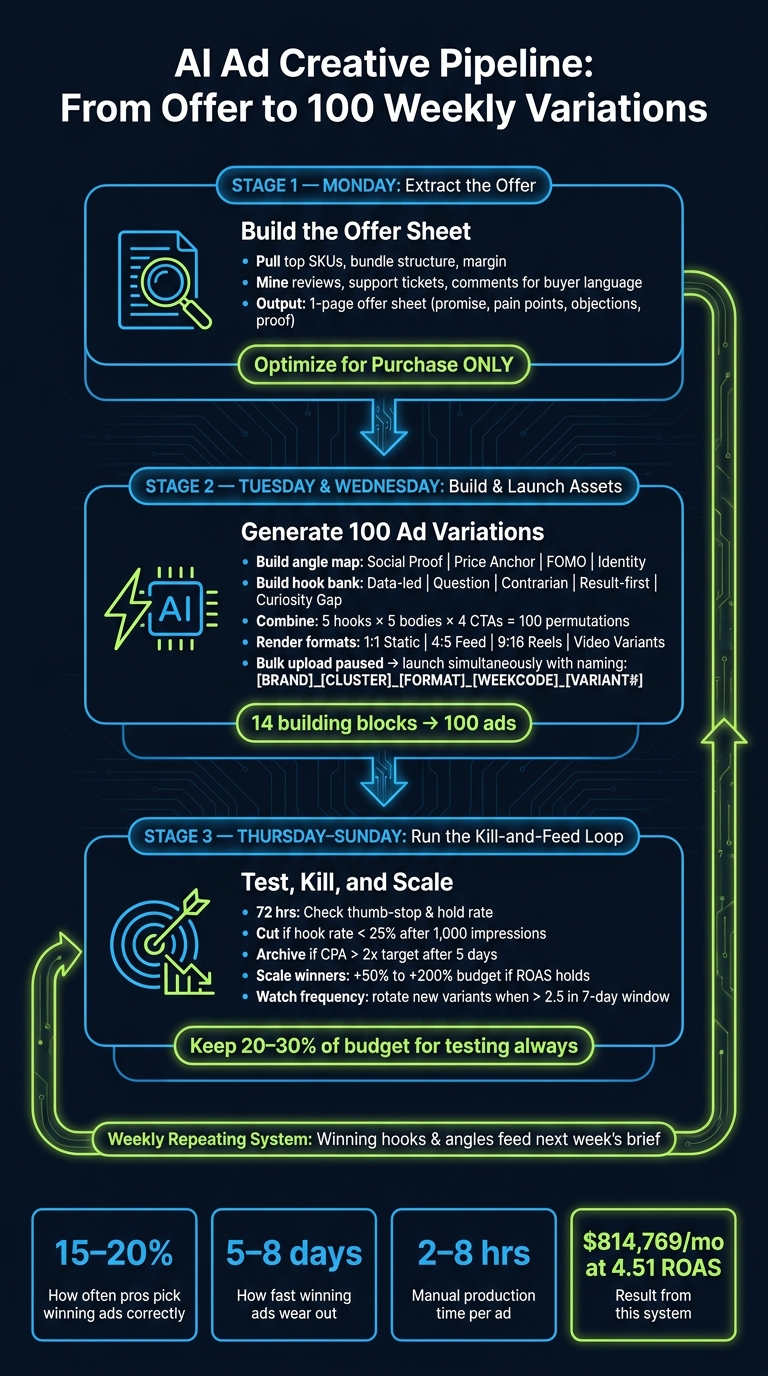
How to Test 100 Facebook Ad Variations a Week: The AI Creative Loop
Step 1: Extract the Offer Before Making a Single Ad
Here’s the exact pipeline I use.
Every batch starts with the offer, not the design. Before I make a single frame, I pull top-selling SKUs, bundle structure, and margin. Then I dig into support tickets, reviews, and comments. That gives me the exact language buyers use.
The output is a one-page offer sheet with the core promise, pain points, objections, and the proof or guarantee that lowers friction. That document becomes the brief. Everything that comes after ties back to it.
That’s the point: keep creative volume tied to buyer demand, not design taste.
Optimization stays on Purchase only. No add-to-carts. No initiate checkouts.
Step 2: Turn One Offer Into Angles, Hooks, Statics, and AI Video Variants
Once the offer sheet is done, I turn it into angles I can test.
I build an angle map. Each angle goes after a different buying trigger: social proof, price anchor, FOMO, and identity alignment. These are separate hypotheses, not just themes. That distinction matters, because it lets me make more variants without guessing.
From there, I build a hook bank. Hooks follow set patterns:
- Data-led
- Question
- Contrarian
- Result-first
- Curiosity gap
I pair those hooks with body copy and CTAs to make modular combinations. Five hooks, five bodies, and four CTAs give me 100 permutations from 14 building blocks. ADEN'S LAB takes those inputs and renders them into 1:1 statics, 4:5 Feed, 9:16 Reels, and video variants.
Step 3: Run the Kill-and-Feed Loop Every Week
Then the batch goes live, and the data decides what stays.
I optimize on Purchase data only. Within 72 hours, thumb-stop and hold show me which ads to kill before spend compounds. By day 5, if an ad hasn’t cleared the learning phase, I pause it - no exceptions.
Every winner becomes the starting point for the next week. The hooks and angles that drove purchases go straight back into the next brief, so the pipeline compounds over time instead of starting from zero each cycle.
The AI Creative Engine at /services runs this loop end to end. ADEN'S LAB shows the full output at /work/adenslab.
How I Actually Test 100 Facebook Ad Variations a Week
A Simple Campaign Structure Built Around Purchase Data
Here’s what the kill-and-feed loop looks like when I’m in the weeds with it.
I run one testing campaign that’s separate from scaling. For testing, I use ABO so each variation gets the same chance to spend. That matters because it stops new ads from getting buried under old winners.
I group tests by angle cluster and format, so each batch answers a single question instead of turning into a mess. I optimize for Purchase only. Meta Ads Manager handles delivery, and I use Shopify, TripleWhale, Hyros, Klaviyo, and Stripe to check purchase revenue on the back end.
My Weekly Batching System for Reaching 100 Variations
My week follows the same rhythm.
On Monday, I turn the offer into 5–10 new angles. On Tuesday, ADEN'S LAB builds the assets: statics in 1:1 and 4:5, Reels in 9:16, plus video variants. On Wednesday, I bulk upload everything into Meta Ads Manager using one fixed naming format: [BRAND]_[CLUSTER]_[FORMAT]_[WEEKCODE]_[VARIANT#]. I upload the ads paused first, then launch them at the same time.
From Thursday through Sunday, the test runs. Then on Monday, I cut the losers and push the winning angles into the next brief.
At that point, I’m not grading the ad on how clever it looks. I care about one thing: does it convert?
Budget Rules: Test Constantly, Scale Winners Hard
I keep 20% to 30% of the total account budget reserved for testing at all times. I protect that slice. If a scaling campaign has a rough week, I still don’t steal from testing to keep it alive.
The kill rules are simple:
- If hook rate is below 25% after 1,000 impressions, the ad gets cut.
- If CPA is more than 2x target after 5 days, I archive it. No exceptions.
Scaling is the flip side. Once a creative holds target ROAS on purchase data, I increase budgets by 50% to 200% if the ad can handle it. The $814,769/month at 4.51 ROAS came from acting when the data gave the green light.
One metric I keep a close eye on as spend goes up is frequency. When it passes 2.5 in a 7-day window, CTR starts to decay. That’s my cue to rotate in new variants from the testing pipeline and swap them into the scaling campaign.
Volume means nothing if the creatives don’t clear the conversion bar.
What Makes AI-Generated Facebook Ads Convert - and Where This Goes Next
The Conversion Standards I Apply to Every AI Asset
Once an ad wins testing, I put it through a much tougher conversion check before I scale it. A polished ad is not the same as an ad that drives purchases.
Every AI asset I approve has to pass the same bar before it goes live. The first frame needs a pattern interrupt - motion, strong contrast, or a direct problem statement. The first 1.5 seconds matter most. That’s the window where the scroll stops or keeps going.
After that, the main benefit needs to come through within 3 seconds. No slow setup. No brand-story intro. Just the value, right away.
Past the hook, I look for a few non-negotiables:
- Clear product visibility
- Benefit-first copy
- Text that stays readable in every placement size
- A direct CTA
I also want context that feels grounded in everyday use. If proof exists - a result, a number, a transformation - it goes in. Proof sells.
Meta also requires AI-generated content that shows realistic people to be labeled during the upload flow. Miss that step, and you can run into account issues.
How I Extend Winners Across Placements, Retargeting, and Peak Periods
Once a winner clears purchase data, the work changes. At that point, it’s no longer about testing. It’s about multiplication.
I don’t retire a winning ad. I rebuild it across formats. That means recutting it into 9:16 for Reels, 1:1 for Feed, and 4:5 for mobile placements. I also make retargeting versions for people who already know the product. Same signal. Different wrapper.
For peak periods, I build the variant library ahead of time. I never want to scramble for new creative during a BFCM window. The Black Friday campaign that drove $544,397 in 72 hours ran on assets that were prepped and tested before the sale started - not thrown together under pressure. That’s why I build variant libraries before demand spikes.
The rule is simple: keep the winning signal, change the wrapper.
If you want me to look at your current creative setup and tell you exactly where the bottleneck is, Book a 30-minute strategy call - direct with me, you leave with a diagnosis either way.
FAQs
How much budget do I need to test 100 ad variations a week?
A common starting budget for testing 100 ad variations per week is $1,500 to $3,000 per month. On a per-creative basis, that’s usually about $50–$100 per variation.
The exact spend depends on two main things: your cost per result and how much data you need to reach statistical significance.
Why do you use ABO instead of CBO for creative testing?
I use ABO for creative testing because it gives me tighter control over spend. That matters when you want each creative variation to get a fair shot instead of letting one option soak up budget too early.
CBO works better when the goal is to see which creative the algorithm leans toward in a live setting. But for systematic, hypothesis-driven testing, ABO is the better fit.
How do I know when a winning ad is starting to fatigue?
A winning ad usually starts to wear out when frequency climbs past 2.5 over a 7-day window, CTR begins to slide within 5 to 10 days, and key signals like hook rate or CTR drop sharply.
At that point, the ad is often losing relevance and pulling in less engagement.