ASC vs Cost Caps vs Bid Caps: Choosing a Meta Bidding Strategy in 2026


If your offer works, bidding is often the lever that changes scale, CPA, and delivery. In this piece, I’d frame the choice simply: use ASC for volume, cost caps for scale with a CPA guardrail, and bid caps only when you need a hard auction limit.
Here’s the short version:
- ASC works best when you already have enough conversion data and want Meta to find more volume.
- Cost caps work best when your trailing CPA is steady and you want more spend without losing control.
- Bid caps fit narrow cases where unit economics are tight and underdelivery is an acceptable trade-off.
- If your cap is set below your actual recent CPA, delivery often drops.
- For ecommerce, I’d optimize for purchase. For SaaS, I’d optimize for one main conversion event closest to revenue.
The article is built around a plain decision tree based on purchase volume, CPA clarity, tracking quality, ad depth, and margin room. It also shows how I’d layer these setups in one account: ASC as the base, cost caps for scaling, bid caps for rare edge cases.
Quick Comparison
| Strategy | Best use | Main upside | Main risk | Control |
|---|---|---|---|---|
| ASC | Building volume and broad scale | More delivery, less manual work | Less control over CPA swings | Low |
| Cost Cap | Scaling with CPA limits | Better balance of spend and efficiency | Throttled delivery if cap is too low | Medium |
| Bid Cap | Tight auction control | Hard bid ceiling | Low delivery and missed auctions | High |
One proof point stands out: the article cites $1,011,172 spent through one cost-cap campaign at 3.90 ROAS. That supports the main point: once Meta ads management basics are in place, the bidding model can shape the result more than targeting tweaks do.
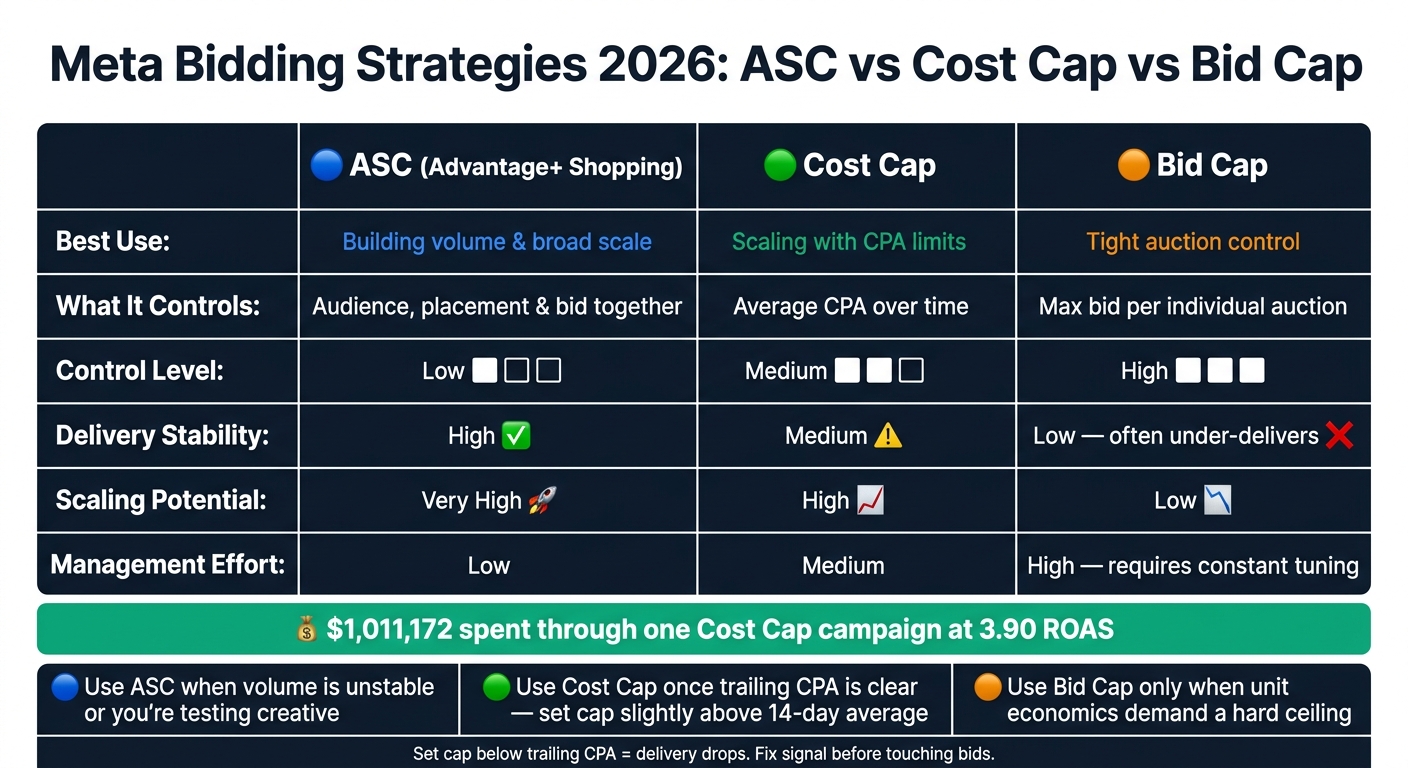
Meta Bidding Strategies 2026: ASC vs Cost Cap vs Bid Cap
What ASC, Cost Caps, and Bid Caps Actually Do
Before you choose a strategy, you need to know what each one controls inside Meta’s auction. They’re not the same thing. Each one gives Meta a different amount of freedom.
ASC Default Bidding: Volume First, Control Second
ASC gives Meta the most room to steer audience, placement, and bid. It combines prospecting and retargeting in one campaign. In ASC, the creative does most of the targeting work.
ASC tends to work best once the pixel has 500+ purchase events in the last 30 days and your budget is around 10–20x your target CPA.
Cost Cap: Average CPA Guardrail With Room to Scale
Cost cap is the strategy most buyers get wrong. A lot of people treat it like a hard ceiling on every purchase. It’s not. Meta can go above your cap on one conversion if cheaper conversions balance it out over time.
I’ve run $1,011,172 through one cost-cap campaign at 3.90 ROAS. That’s why I use it when I want scale without choking delivery.
The mistake I see most often is simple: set your cost cap at or slightly above your 14-day average CPA, not your dream CPA. If you set it too low, Meta often throttles delivery.
Bid Cap: Hard Auction Ceiling for Advanced Accounts
Bid cap is the most precise of the three, and also the easiest to break. It sets a hard ceiling on each auction bid. If the auction clears above your cap, Meta drops out.
That sounds great on paper. But in many accounts, it leads to under-delivery. Bid cap controls the auction, not the final CPA.
Here’s how the three strategies stack up on the metrics that matter:
| ASC | Cost Cap | Bid Cap | |
|---|---|---|---|
| What it controls | Audience, placement, and bid together | Average CPA over time | Max bid per individual auction |
| Control level | Low | Medium | High |
| Delivery stability | High | Medium | Low - often under-delivers |
| Scaling potential | Very high | High | Low |
| Management effort | Low | Medium | High - requires constant tuning |
Now the question shifts from what each bid strategy does to when I use each one.
When Each Strategy Wins
When I Start With ASC
ASC is where I start for most ecommerce accounts.
It tends to work best when the setup is simple: one clear offer, clean purchase data coming through CAPI, and steady purchase volume. In that setup, creative does most of the targeting work. But that only happens when the account already has clean purchase data and one clear conversion event. For SaaS, I follow the same idea around the main conversion event.
ASC usually wins in accounts where the founder stops obsessing over audience segmentation and puts that energy into making more ads instead. That shift matters. More creative usually does more for performance than slicing audiences into smaller and smaller groups.
If I'm under that threshold, I fix the offer and the funnel first. ASC won't save a weak setup.
When I Add Cost Caps to Push Harder
Once ASC is stable, I move to cost caps when I want more volume without giving up CPA control.
I don't use cost caps on day one. I add them after an account already shows stable, profitable performance and I know the CPA I can live with. If I don't know my acceptable CPA, I'm not ready to use them yet.
At that point, cost caps become my main way to scale. When a campaign holds, I scale in 50% to 100% jumps. I've run $1,011,172 through one cost-cap campaign at 3.90 ROAS - the same hard seasonal scaling approach shows up in the BFCM 2025 breakdown.
When I set the cap, I use the trailing 14-day average CPA or go a bit above it. Not the CPA I wish I had. The one the account is hitting now, with a little room built in.
When Bid Caps Make Sense - and When They Do Not
Bid caps are a niche tool.
I use them only when I need strict unit economics and tight auction control. Think fixed payout models, or accounts where every acquisition has to land inside a very narrow range. I only use bid cap when the account can handle that level of control.
Outside of those cases, bid caps often hurt delivery. Set the cap too low and Meta stops entering auctions. Delivery falls apart. If a cost cap is already underdelivering, switching to a bid cap usually makes things worse. The algorithm needs some room to find low-cost conversions.
So this is the simple version:
- ASC is my volume tool
- Cost cap is my main scaling lever
- Bid cap is the niche control lever
Next, I'll show the five inputs I check before I touch bidding.
My Decision Tree and Account Structure
The 5 Inputs I Check Before I Touch Bidding
I use five checks to decide if an account is ready for ASC, cost caps, or bid caps.
1. Purchase volume. ASC and cost caps both need enough purchase volume to settle down. If volume is too low, I stick with Lowest Cost and work on getting more purchases first.
2. Target CPA clarity. I look at the trailing 7- to 14-day CPA. Not a goal on a slide. The actual trailing CPA.
3. Tracking quality. I don't touch bidding until CAPI is clean and sales line up with platform data.
4. Creative depth. ASC needs enough ad volume to find winners. If the account has thin creative, the system doesn't get enough signal to learn.
5. Margin room. Tight margins call for a hard CPA guardrail. That's where cost caps come in. If the account has more room to absorb CPA swings, I can stay on Lowest Cost longer before putting limits in place.
How I Mix ASC, Cost Caps, and Bid Caps in One Account
The setup is simple: ASC as the always-on base, cost caps as the scaling layer, and bid caps as the precision layer only when there's a clear reason to use them.
ASC handles most of the spend. I keep it consolidated. If you pile on more ad sets, you split signal, drag out learning, and create internal auction competition. If I'm running prospecting ASC, I exclude customer lists and keep the existing-customer budget cap at 0% so the campaign stays focused on net-new buyers.
Then I layer in cost caps. Once ASC is stable and I know the CPA the account is actually getting, I launch a cost-cap campaign for proven winners. I set the cap a bit above the trailing CPA, not right on the target, because that can choke delivery. If a cost-cap campaign holds, I scale it hard, usually in 50% to 100% jumps.
Bid caps are rare. I only use them when I have deep auction-level data and need a strict ceiling. They belong in accounts that can handle that kind of tight control.
There’s one rule I never break: no overlap without exclusions. Clean separation stops cannibalization.
When these layers are set up the wrong way, one of two things usually happens: delivery falls apart, or margin gets eaten up.
How This Applies to Ecommerce vs. SaaS
The decision tree stays the same. What changes is the input based on the business model.
For ecommerce, the answer is always purchase. Not add to cart. Not initiate checkout. Purchase. Cost caps help protect margin on specific products or during high-spend windows. The math comes back to ROAS and MER.
For SaaS, I optimize around the main conversion event closest to revenue that still has enough volume to learn from. Here, the math shifts to allowable CAC and sales-cycle payback.
Same framework. Different operating metrics.
| Feature | Ecommerce | SaaS |
|---|---|---|
| Primary objective | Purchase | Main conversion event |
| ASC role | Primary scaling engine | Secondary; often used for lead campaigns |
| Bidding strategy | Lowest Cost, then Cost Cap for margin control | Lowest Cost, then Cost Cap for CAC guardrails |
| Targeting approach | Broad / Advantage+ Audience | Interest stacks / lookalikes / ABM lists |
| Decision driver | ROAS and MER | Allowable CAC and payback period |
| Signal source | Catalog + CAPI | CRM + CAPI |
The table is a guide, not a rulebook. Most failures come from setup, not bidding.
Common Misconfigurations and Final Take
The Mistakes That Kill Delivery or Kill Profitability
Once you understand what each lever does, the next issue is usually the setup. ASC tends to struggle when signal is weak. Cost caps tend to miss when the CPA target is just a guess. And bid caps tend to choke delivery when too much control gets forced into the system.
A cap set below your trailing CPA can crush delivery. The better move is simple: set the cap above where performance sits now, not where you hope it goes next.
If Event Match Quality is weak, fix CAPI first. That comes before bid changes. And if you have too many campaigns splitting signal, learning slows down. In that case, consolidate.
A weak cost cap should not be swapped over to a bid cap. Bid cap is tighter, not looser. It is not the tool to save underdelivery.
Bidding also will not save a weak offer or stale creative. If CPA keeps climbing and signal is clean, the issue is usually ad fatigue. At that point, refresh the hooks.
Once the account is set up cleanly, the decision gets much easier.
My Simple Rule Set for Choosing in 2026
If volume is still unstable, use ASC. Start with ASC when you're building volume or testing new creative. Let it run without tight limits until you know what the market is paying for a conversion.
If trailing CPA is clear, use cost caps. Move to cost caps once conversion volume is steady and you have a clear trailing CPA. Set the cap slightly above that trailing average. I've pushed $1,011,172 through one cost-cap campaign at 3.90 ROAS.
If you need a hard ceiling, use bid caps. Use them only when unit economics give you a strict cutoff and you need to stop bidding above a fixed price. Most accounts do not need this.
Clean signal, enough volume, and creative that converts come first. When that base is in place, bidding becomes a lever, not a repair tool.
If you want a diagnosis of where your account sits right now, book a 30-minute strategy call - direct with me, you leave with a diagnosis either way.
FAQs
How do I know if my account is ready for ASC?
Look at three things: purchase volume, tracking quality, and account maturity.
ASC tends to work best when Meta has enough data to learn with some consistency. A common benchmark is at least 50 purchase events per week. If you’re below that - especially if you’re spending under $30–$50 per day - results can get shaky.
Accurate conversion tracking matters too. That includes CAPI, along with enough catalog depth and enough creative volume to give the system room to work. If your data is thin or your asset pool is small, manual campaigns are usually the better fit until those signals get stronger.
What should I do if a cost cap campaign stops delivering?
Usually, the cap is too low. Set your cost cap in line with your trailing 14-day average CPA, or a bit above it, and make sure the campaign has enough conversion volume to work with.
If delivery is still weak, the cap is probably too tight for what your market is asking for. Increase it little by little, watch performance closely, and avoid changing bid strategy too often since that can reset learning.
When is bid cap actually the right choice?
Bid cap works best when you know the auction at a granular level, understand your margin per conversion, and need tight control over each bid.
It’s usually a good fit for accounts with deep auction data or high-value SKUs. The catch is simple: set the cap too low, and delivery can drop fast.
Continue with a focused diagnosis
Use these guides when the next decision needs a more specific worksheet or investigation.