How Many Ad Creatives Do You Need to Scale Meta Ads? (The Real Testing Math)


Most Meta ads fail. If only 6% to 7% of ad variants become winners, you do not start with a fixed number of ads. I’d work backward from monthly spend, target CPA, and hit rate.
Here’s the short answer:
- If you spend under $50,000/month, I’d plan for 3 to 10 new ads per week.
- If you spend $50,000 to $200,000/month, I’d plan for 15 to 40 per week.
- If you spend $200,000+/month, I’d plan for 40 to 100+ per week.
- I would not judge a test until it spends at least 2x target CPA.
- I’d keep only 3 to 5 ads per ad set so signal does not get split.
- As spend climbs, fatigue hits faster: many winners fade in 7 to 14 days, and at high spend even every 2 to 3 days.
That means scaling Meta is less about making “more ads” and more about keeping a steady weekly pipeline of new tests and replacements.
| Monthly Spend | New ads/week | Winners live at once | Fatigue pace |
|---|---|---|---|
| Under $50,000 | 3–10 | 3–15 | Lower; swap every 3–4 weeks |
| $50,000–$200,000 | 15–40 | 20–80 | Higher; swap every 1–2 weeks |
| $200,000+ | 40–100+ | 80–300+ | Very high; replace every 2–3 days |
A few rules matter most:
- Test and scale in separate campaigns
- Keep 10% to 20% of spend in testing
- Promote winners in 48 hours when data is clear
- Cut losers by 72 to 96 hours
- Watch frequency, CTR, CPA, and purchases, not just Meta’s top-line numbers
In short: I’d treat Meta growth like a numbers game. If your winners burn out fast and only a small share of tests work, your weekly output has to match that math.
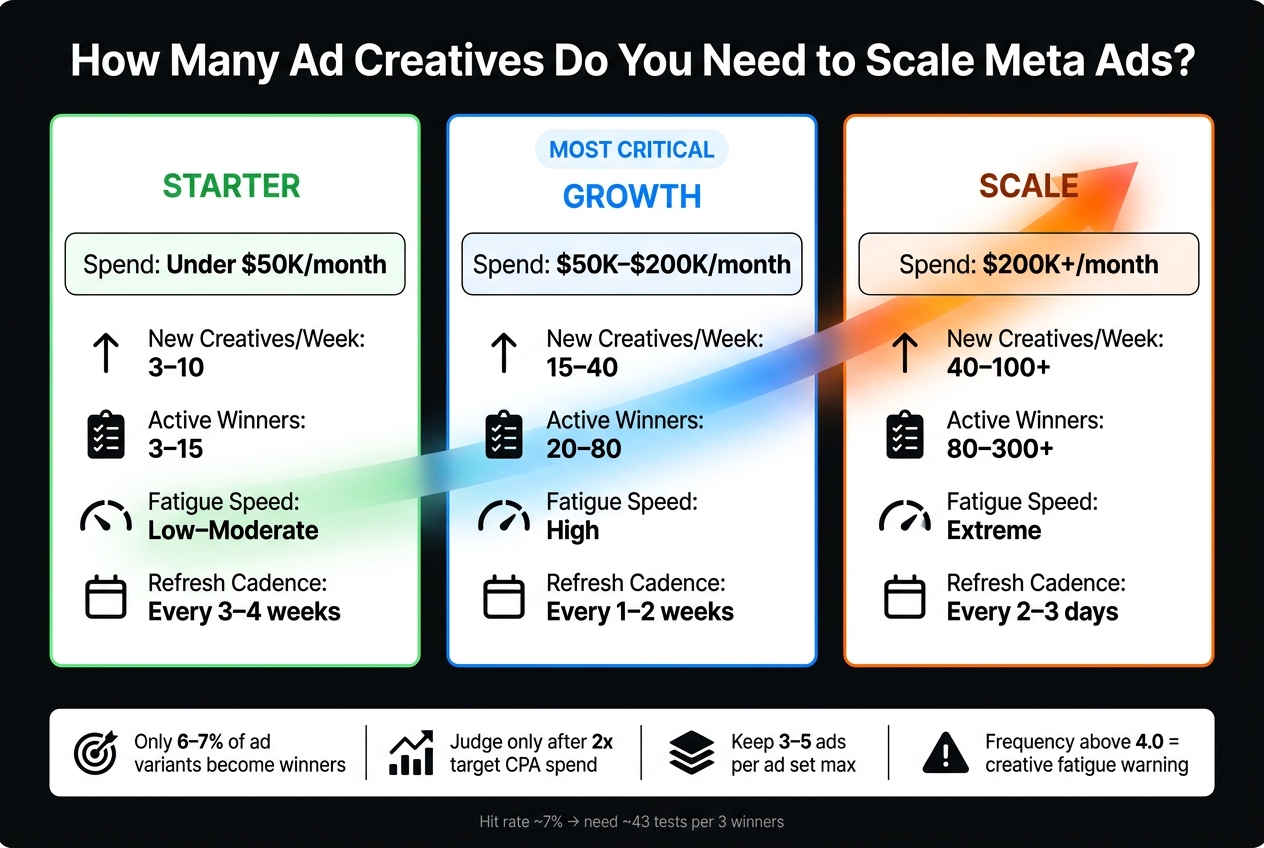
Meta Ads Creative Volume by Monthly Spend Tier
The real testing math: hit rates, signal, and fatigue
Most creatives lose, so your testing plan must assume failure
Most ads don't make it. About 93% to 94% never get real budget. Only 6% to 7% turn into scale winners. And those winners usually spend 10x the median ad spend in the account.
That shifts the math in a big way. If you need 3 winners this month, and your hit rate is 7%, you need roughly 40 to 45 new variants. That's why spend tier matters more than setting some fixed creative count and hoping it works.
How much data an ad needs before you trust it
Bad signal leads to bad scaling decisions. So I keep a few hard rules.
I don't judge a creative until it spends at least 2x target CPA. If your target CPA is $50, that means a $100 minimum.
For a cleaner ranking read, I want 15 to 20 purchases per week at the creative level. Below that, performance gets noisy.
Meta also needs roughly 50 conversions per week per ad set to steady delivery. That's why I keep ad sets tight. If you cram in too many ads, you split the signal and slow the learning process. Meta tends to pick an early winner and starve the rest.
So the sweet spot is simple:
- Keep 3 to 5 ads per ad set
- Wait for enough spend and purchase volume before making calls
Why creative fatigue gets worse as spend climbs
Once you have a clean read, the next limit is fatigue.
The more budget a winner gets, the faster it burns out. Higher spend shortens the lifecycle because the signal gets used up faster. At lower spend, a creative can last 21 to 35 days. In the $20,000 to $100,000 range, that drops to 10 to 14 days. At $100,000+, it's often just 7 to 10 days.
Frequency is the warning light. Once frequency goes above 4.0, conversion rates can fall hard. If CTR drops more than 20% over two weeks and CPA is climbing, I treat that creative as done.
That also means higher-spend accounts need a much faster replacement pace.
Now I break that math down by monthly spend.
How many ad creatives you need at each spend tier
The math shifts as monthly spend goes up. Treat these as working ranges, not fixed rules. And these numbers are weekly replacement targets, not your total creative library.
| Monthly Spend | New test creatives/week | Budget-carrying winners live at once | Fatigue risk |
|---|---|---|---|
| Under $50,000 | 3–10 | 3–15 | Low–Moderate (refresh every 3–4 weeks) |
| $50,000–$200,000 | 15–40 | 20–80 | High (refresh every 1–2 weeks) |
| $200,000+ | 40–100+ | 80–300+ | Extreme (continuous replacement; every 2–3 days) |
Under $50,000/month: slower fatigue, smaller test bench
At this level, fatigue tends to move more slowly. That gives you a bit more breathing room on testing speed, but the hit-rate math stays the same.
In most cases, 3 to 10 new creatives per week is enough to keep the account from going stale. You also want 3 to 15 active winners carrying spend at any given time. With this hit rate, it still takes about 15 tests to get one winner.
I usually start with static ads. They cost less to make and are fast to test.
$50,000 to $200,000/month: where creative starts limiting scale
This is the range where a lot of brands stall out. Creatives start burning out faster than the team can replace them.
You need 15 to 40 new creatives per week and 20 to 80 active winners in rotation. Keep test ads separate from spend-carrying ads so your signal stays clean.
At this tier, creative is no longer just support for media buying. It becomes a core growth constraint. Put simply: the limiter is no longer budget. It's how fast you can replace tired ads.
$200,000/month and above: creative throughput becomes the bottleneck
At this spend level, you're not just testing creatives anymore. You're running a production system.
You need 40 to 100+ new variants per week and 80 to 300+ active winners in rotation. At higher spend levels, winners can fatigue in 7 to 10 days, and sometimes even faster.
At this level, I use ADEN'S LAB to keep replacement volume ahead of fatigue. When a winner proves itself, I scale it hard. That's the moment when replacement volume matters most.
Keep reserve winners ready before the current ones fade.
Next, I'll show the weekly testing cadence that keeps these ranges alive.
How to build a weekly testing cadence that supports aggressive scaling
This weekly math only works if testing and scaling stay separate. Mix them together, and every budget change muddies the read. The replacement targets only make sense when testing has its own lane and scaling has another.
Separate testing from scaling so decisions stay clean
I run two campaign types: one for testing new creatives, and one for scaling ads that already work. That split keeps the replacement engine ahead of fatigue.
I keep 10–20% of spend in testing and the rest in scaling. New concepts stay in testing until they prove themselves. Only ads that have already earned that spot move into scaling.
That setup keeps the signal clean. If a new ad sits beside a proven winner in the same campaign, it gets messy fast. A drop could come from the ad itself, or it could come from budget competition inside the campaign. At that point, you're not reading performance. You're reading noise.
I use a 48- to 96-hour read on tests.
| Testing Campaign | Scaling Campaign | |
|---|---|---|
| Job | Find winners | Maximize revenue |
| Budget share | 10–20% of total spend | 70–80% of total spend |
| Ads inside | New concepts, unproven variants | Proven winners only |
| Decision window | 48–96 hours to promote or kill | Daily monitoring for fatigue |
| Kill rule | No purchase after enough spend to judge at 2x CPA | CPA 20%+ above target for 3+ days |
Every Monday, I review the last 7 days. Any test that hasn't earned a purchase by the 2x CPA mark gets paused.
Once the test side is clean, I can scale hard without second-guessing every move.
Use aggressive budget increases when the ad earns it
When an ad proves itself, I don't tiptoe the budget up. I move.
50% increases are standard. In clear winner cases, 100% to 200% can hold. By comparison, small 5% to 20% bumps are just too slow once you've found something that's working.
There's a catch, though. Bigger jumps need more replacement creatives waiting behind them. If that bench isn't ready, the winner starts to fade and scale stalls out.
So after the increase, I watch performance every day and pull back before fatigue drains the ad.
Track the right numbers each week
I run every decision through the same short list:
- spend
- purchases
- CPA
- ROAS
- frequency
Frequency above 4.0 is a warning sign. And if CTR drops more than 20% over two weeks, that's a sign the creative is losing steam.
Meta gives me the first read. Then I check purchases and revenue in Shopify, TripleWhale, Hyros, or Stripe. If the platform data and the revenue data don't line up, I trust the revenue.
I promote winners within 48 hours and cut clear underperformers within 72–96 hours.
Build the creative machine, then scale it
One great ad won't scale Meta. A system that keeps producing winners will.
Once fatigue starts moving faster than your team can replace winners, creative becomes the bottleneck. That's what happens at higher spend levels. If you want to stay efficient, you need winners replacing losers before fatigue hits.
ADEN'S LAB is how I keep that bench stocked. It has produced tens of thousands of creatives, with statics and AI video variations running through a steady pipeline instead of being made in one-off batches.
What this looks like in real accounts
These results came from accounts with enough replacement volume to stay ahead of fatigue:
- August 2025: $814,769 in one month at 4.51 ROAS
- BFCM 2025: $544,397 in 72 hours
the real estate AI SaaS tool makes the point in plain English. That account grew from $15,000 to $150,000/month in six months while CPA fell by $8. The BFCM case shows what it looks like when the system is built before the moment arrives, instead of scrambling to make ads during the biggest spend window of the year. You can see more on both here: /work/real-estate-ai-saas-tool and /work/blackfriday.
If the bench is thin, scale stalls. If the bench is full, spend can keep climbing.
So the next question isn't how many ads to make once. It's how to keep the bench full every week.
If you want to see what that could look like for your account, view my services or book a 30-minute strategy call - direct with me, you leave with a diagnosis either way.
FAQs
How do I calculate how many creative tests I need each month?
Start with the hard truth: most creatives lose.
Win rates usually land around 6% to 10%. That means you can’t count on a handful of tests to carry the account. You need enough shots on goal for winners to show up.
If your target is 3 to 5 scale winners, plan to test 50 to 80 distinct variants per month.
At $50,000 to $250,000/month in spend, you should be aiming for at least 50 new creatives a week. Once spend moves higher, that target jumps to 100+ per week.
What counts as a real winner in Meta ad testing?
A real winner in Meta ads is defined by data at scale, not guesswork.
In practice, a creative starts to count only after it has spent at least 10x the account median. Many teams also use a floor like $500 to make sure the ad has enough data behind it.
Here’s why that matters: most ads never get enough budget to tell you much. Meta’s system tends to push spend toward the small number of variants that show early signs of engagement and conversions.
So if an ad shows a short burst of good results on very little spend, be careful. That may just be a statistical blip, not a real winner.
How do I know when creative fatigue is killing scale?
Creative fatigue usually doesn’t show up as a gentle decline. It hits more like a cliff.
You’ll often see ROAS fall fast as Meta burns through the audience linked to that creative’s signal pattern. And yes, even a winning ad can wear out in as little as seven to ten days.
Don’t rely on gut feel here. Watch CPA closely. If it starts to climb while your creative metrics stay flat, fatigue is probably setting in.
When your top ads keep losing efficiency, the fix is simple in theory but hard in practice: you need new, meaningfully different concepts and a steady weekly replacement cadence.