Facebook Ad Creative Fatigue: How to Spot It Early and Refresh Without Resetting Learning

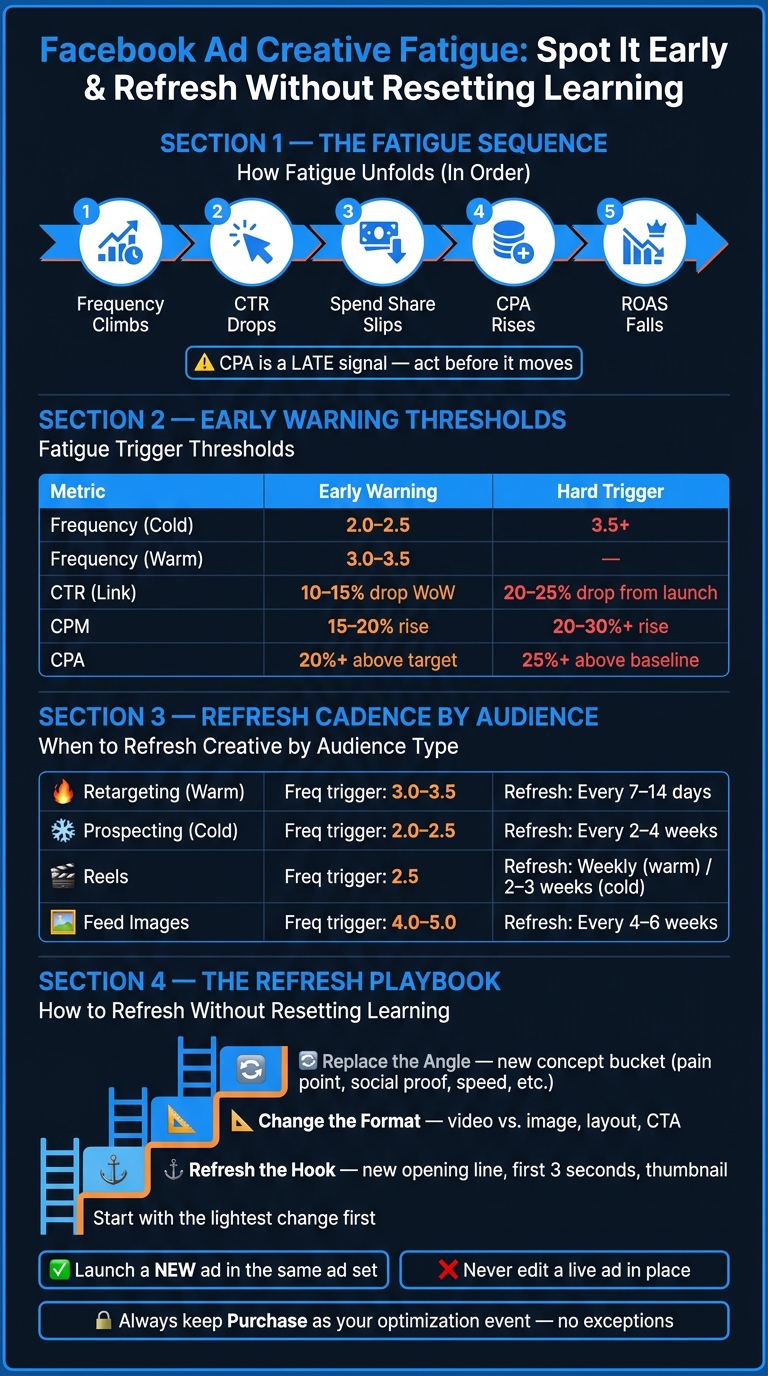
If your Meta ad is losing steam, don’t wait for CPA to jump. I look for fatigue when frequency climbs, CTR drops, and spend share starts slipping - because by the time cost per purchase gets worse, the slide is often already in motion.
Here’s the short version:
- Bad ads fail early. Fatigued ads win first, then wear out.
- I compare each ad against its own first 7-day baseline, not account averages.
- My main warning signs are:
- Cold frequency: around 2.0 to 2.5
- Warm frequency: around 3.0 to 3.5
- Link CTR: down 10% to 15% week over week
- Hard CTR trigger: down 20% to 25% from launch
- CPA: often moves later
- I don’t edit a live ad in place if I want to keep learning data intact.
- I add a new ad in the same ad set, keep Purchase optimization the same, and pause the old winner only after the replacement settles.
- I start with the lightest change first:
- Hook
- Format
- Angle
A few numbers shape my timing. For prospecting, I often look at a swap in the 2- to 4-week range. For retargeting, it can be every 7 to 14 days. At higher spend, fatigue tends to show up sooner because you burn through the same audience faster.
| What I check | What it often means |
|---|---|
| Frequency up + CTR down | Ad is wearing out |
| CPA up, but CTR and frequency steady | Look at funnel, offer, or tracking first |
| CPM up across the account | Auction pressure may be the issue |
| Spend share dropping on a past winner | Meta is backing away from that ad |
The main point: don’t kill a winner too early, and don’t wait too long either. Watch the sequence, rule out tracking or funnel issues, then rotate based on angle and volume so scale doesn’t stall.
Below, I break down how I read those signals and what I change first.
Facebook Ad Creative Fatigue: Early Warning Signals & Refresh Playbook
What Facebook Ad Creative Fatigue Looks Like Before Performance Breaks
A bad ad fails early. A fatigued ad decays after it wins
These are two different problems, and mixing them up leads to bad calls, especially swapping ads too soon.
A bad ad never had message-market fit. It launches cold, gets a weak response, and fades fast. A fatigued ad is different. It already showed it could win. The issue isn't fit. It's exposure. It drives purchases, holds ROAS, and then starts to slip after people see it too many times.
What matters most is the sequence, not any one metric by itself. When hook retention drops below its first-week baseline, CTR tends to fall next. Then CPA starts to climb, and Meta shifts delivery away from the ad that used to lead. That's why CPA is a late signal. By the time it moves, the slide has often started already.
I also watch delivery share as part of my Meta Ads Management Services. If a top ad is losing spend share over a few days, Meta is already backing away from it
That pattern is what I check in Ads Manager before CPA moves.
Why fatigue hits faster at higher spend and in smaller audiences
After you find the winner, spend level and audience size shape how fast fatigue shows up.
If you scale fast, you move through the same receptive users faster too. More spend burns through the responsive audience at a faster clip. Smaller audiences and warm pools wear out even sooner because the same people keep seeing the same creative again and again.
I optimize for Purchase only. When the right buyers stop converting, fatigue shows up fast. That's why I track the sequence instead of staring at one metric in isolation: frequency goes up, CTR starts to slip, and CPA follows.
Next, I break down the exact metrics I check first in Ads Manager.
How I Diagnose Creative Fatigue Using Frequency, CTR Decay, and CPA Drift
The Metrics I Check First in Ads Manager
I keep my Ads Manager columns focused on Purchases, Cost per Purchase, ROAS, CTR (Link Click-Through Rate), CPM, Frequency, Impressions, and Amount Spent. Then I compare each ad to its own first-week baseline, not account averages or outside benchmarks.
That part matters more than most people think. An ad can look fine next to account-wide numbers and still be slipping. I also check frequency at the ad level. Campaign-level frequency can hide one worn-out ad behind newer ones that are still doing fine. The baseline is what shows whether that specific ad is starting to fade.
The Fatigue Pattern: Frequency Up, CTR Down, CPA Up, ROAS Down
The pattern I watch is pretty simple: frequency goes up first, CTR starts to drop, and then CPA and ROAS follow behind. After that, CPM often climbs as delivery gets tougher.
So I treat frequency and CTR as the early signals. CPA and ROAS usually lag.
I read these shifts over 3- to 7-day rolling windows because single-day moves are often just auction noise. If CTR drops for three straight days, that ad gets my attention. Here’s where I usually draw the line:
| Metric | Early Warning | Hard Trigger |
|---|---|---|
| Frequency (Cold) | 2.0–2.5 | 3.5+ |
| CTR (Link) | 10–15% drop week over week | 20–25% drop from launch baseline |
| CPM | 15%–20%+ rise | 20%–30%+ rise without an external cause |
| CPA | 20%+ rise from target | 25%+ rise from baseline |
Once that pattern shows up, I don’t assume it’s fatigue right away. I separate it from offer issues, funnel problems, and tracking errors first.
How to Tell Fatigue Apart From an Offer Problem, Funnel Issue, or Market Shift
A rising CPA does not always mean fatigue. This is where people get tripped up.
If frequency is flat and CTR is stable, but CPA is climbing, I look downstream first. In plain English: I check the parts after the click before blaming the ad. I rule out tracking and backend issues first, then I decide whether fatigue is the cause.
I also cross-check Meta against Shopify or TripleWhale. If Meta shows a drop in conversions but the backend still shows steady purchases, that points to a tracking problem.
If CPM jumps across the board while CTR stays fairly stable, I look at auction pressure before anything else. And if every new creative concept stalls within about 7 days, the issue is upstream.
When the signal points to fatigue, I refresh the winner without resetting learning.
How to Refresh Fatigued Creatives Without Resetting Learning
Once I know the issue is fatigue - not a funnel problem and not a tracking miss - the next step is a refresh. But the way you do that matters just as much as the timing.
The mistake I see most often is simple: people edit a live ad in place. They swap the image, rewrite the copy, or tweak the video inside an active ad. That resets optimization and pushes the ad back into learning. In plain English, the algorithm loses the history it had built.
The better move is to launch a new ad inside the same ad set. Leave the original alone. Then pause the tired ad only after the replacement has settled in. And keep the Purchase objective locked. If you change the optimization event, you change the signal the system is using.
From there, I make a call: do I refresh the execution, or do I replace the angle?
When I Iterate the Winner Instead of Replacing It
If the angle still works but engagement starts to slip, I change the packaging before I change the message. A hook refresh can often bring an ad back without forcing a full rebuild.
That usually means:
- a new opening line
- a different first 3 seconds of video
- a thumbnail swap
- a cleaner CTA
I only move to a full angle change when those top-layer updates stop working.
That decision shapes the next step: keep the post ID or launch a new one.
When to Keep the Post ID and When to Launch a New One
Post IDs carry social proof - likes, comments, and shares. If the main angle still holds up and I'm only making small packaging changes, I'll keep the existing post ID so that engagement stays with the ad.
But when the concept itself is worn out - the audience has seen that angle too many times and started tuning it out - I launch a new post ID based on what the first ad taught me. Same lessons, new delivery.
If the angle still works, keep the post ID. If the concept is done, start clean.
When the angle is the part that's tired, I rotate by concept instead of swapping creatives at random.
Angle Rotation Beats Random Creative Swapping
I group refreshes into angle buckets: pain point, social proof, speed, quality, founder story, and objection handling. When one ad inside a bucket starts to fade, I replace it with another execution of that same angle before I switch to a different angle.
I also stagger refreshes. Replacing only part of the active ads at a time helps keep the whole account from hitting learning all at once. That helps stop fatigue from dragging down scale.
How creative volume stops fatigue from capping scale
Why more creative depth lets me scale budgets aggressively
Angle rotation only works when the next ads are already done.
That’s where a lot of accounts get stuck. It’s usually not the budget that slows scale. It’s the moment the account runs out of enough creative depth to keep going.
When budgets go up, delivery speeds up too. That pushes frequency higher and brings fatigue in sooner. If I don’t have new angles ready to go, there’s less space for the account to absorb more spend. That was the setup behind my Black Friday work, where a single cost-caps campaign spent $1,011,172 at 3.90 ROAS. The only reason that scale held was because the creative bench was deep enough to support it.
The refresh cadence I use for cold and warm audiences
Once the bench starts to thin out, refresh timing matters more than spend size. I don’t refresh on a fixed schedule. I refresh based on signal.
I start replacing winners when frequency goes past 3.5 in a 7-day window and link CTR drops by more than 25% from the first-week baseline.
The timing shifts based on audience size and how warm the audience is. These are the ranges I use.
| Audience Type | Frequency Trigger | Typical Refresh Window |
|---|---|---|
| Retargeting (warm) | 3.0–3.5 | Every 7–14 days |
| Prospecting (cold) | 2.0–2.5 | Every 2–4 weeks |
| Reels | 2.5 | Weekly for warm / 2–3 weeks for cold |
| Feed images | 4.0–5.0 | Every 4–6 weeks |
How ADEN'S LAB gives me the creative volume to stay ahead of fatigue
Late creative production is the bottleneck.
I brief two replacements for every new creative I launch, and I keep one replacement queued for every three active ads. I also build in batches, usually:
- 3 to 5 image variants
- 2 to 3 copy angles per brief
That gives me enough depth to rotate before performance starts to slide.
That’s why I use ADEN'S LAB. It’s the private AI ad engine I built to generate tens of thousands of creatives across my accounts. It keeps a live pipeline ready before fatigue shows up, not after.
the real estate AI SaaS tool proved the model: it scaled from $15,000 to $150,000 per month in 6 months, with CPA down $8, because creative velocity never fell behind spend.
Conclusion: The playbook I use to catch fatigue early and keep scaling
This is the sequence I use when an account starts to show creative fatigue on Meta ads. I look at hook rate and CTR first. CPA usually confirms the issue later.
I track frequency and CTR against each ad’s own launch-week baseline, not account averages. If two early signals show up at the same time - frequency is climbing and CTR is down more than 20% from baseline - I move before ROAS slips.
I start with the easiest fix first:
- Refresh the hook
- Then test the format
- Then test the angle
A hook refresh is usually the fastest first move, and it can often bring performance back without resetting learning.
When those early signals line up, I refresh the creative. I do not change the optimization event. Every campaign stays optimized for Purchase. No exceptions. Changing the event won’t solve fatigue.
Creative volume is what keeps fatigue from turning into a hard cap on scale. If your creative bench is thin, growth will stall, even if you have a strong winner. That’s exactly what the the real estate AI SaaS tool scale showed: going from $15,000 to $150,000 per month in 6 months, it was creative velocity - not budget - that made that growth possible. See my services.
If your account is showing the pattern - frequency climbing, CTR fading, CPA drifting - book a 30-minute strategy call - direct with me, you leave with a diagnosis either way.